


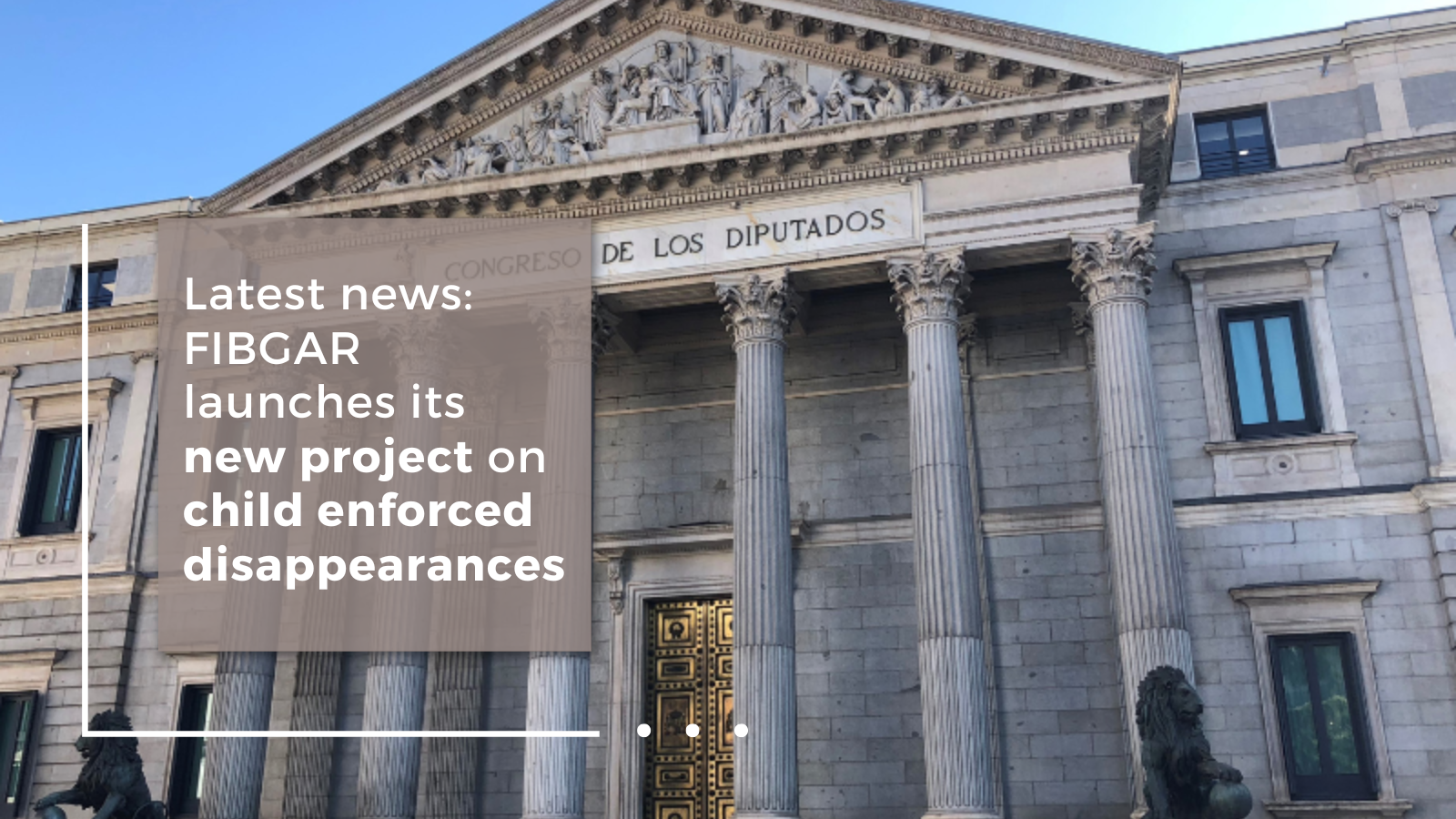
FIBGAR launches its new project on child enforced disappearances
FIBGAR launches a new project in which the foundation’s Democratic Memory area will work throughout this year, aiming to address child enforced disappearances and the issue of stolen babies in Spain from a comprehensive perspective. This initiative focuses on promoting historical memory, justice, and the moral and social reparation of victims, reinforcing the foundation’s commitment to the defense of human rights.
The project “Child Enforced Disappearances: Dialogue for Justice and Legislative Change” is framed within FIBGAR’s Action Commitment 2025–2027, developed in the context of the First International Congress on Enforced Disappearances, held from January 15 to 16, 2025, in Geneva. This congress was co-organized by the UN Committee on Enforced Disappearances (CED), the UN Working Group on Enforced or Involuntary Disappearances (WGEID), the UN Office of Human Rights, and the Convention on Enforced Disappearances Initiative (CEDI).
The Action Commitment 2025–2027 establishes key pillars to address enforced disappearances from a comprehensive approach: education and awareness, support for victims, research and documentation, and policy advocacy. This project is directly aligned with that framework, translating these pillars into concrete actions that strengthen democratic memory and the protection of human rights.
The project seeks to raise awareness and sensitize Spanish society about child enforced disappearances and stolen babies, highlighting the social, psychological, and legal impact of these events. Through a participatory, inclusive, and rigorous process, it gives voice to victims and their families, recognizing their experiences and reflecting the challenges and progress within the current legal framework.
The approval of the Democratic Memory Law in 2022 represented a historic step by legally recognizing children stolen during the Franco regime as victims. However, the legislative proposal on stolen babies remains pending, highlighting the need to accompany the legislative process with actions that raise awareness, inform the public, and mobilize society around justice and reparation for these victims.
To achieve this, the project organizes roundtables and public debates addressing the historical context, social and psychological impact, the current legal framework, and the experiences of victims’ associations. Public participation and the documentation of testimonies and expert contributions ensure that discussions are fully recorded and that the conclusions carry social and political significance.
From these activities, a report and a manifesto are produced, compiling conclusions, demands, and proposals arising from the debates. Both documents consolidate collective memory and serve as tools for public awareness and political advocacy to advance reparation and the recognition of victims’ rights. The findings are disseminated through media campaigns, workshops, lectures, and exhibitions aimed at diverse audiences, including young people and educational groups, reinforcing awareness of democratic memory, human rights, and historical justice.
The project also includes monitoring and evaluation mechanisms to measure the impact of activities, analyze social and media reach, and generate recommendations that ensure the continuity of future initiatives. In this way, awareness-raising translates into concrete actions that contribute to a more just society that is conscious of its history.
Partially co-financed by the Secretariat of State for Democratic Memory, this project reinforces FIBGAR’s commitment to truth, justice, and reparation, consolidating spaces for civic participation and promoting a stronger, more inclusive democracy that respects the rights of those who have suffered child enforced disappearances and stolen babies.
