

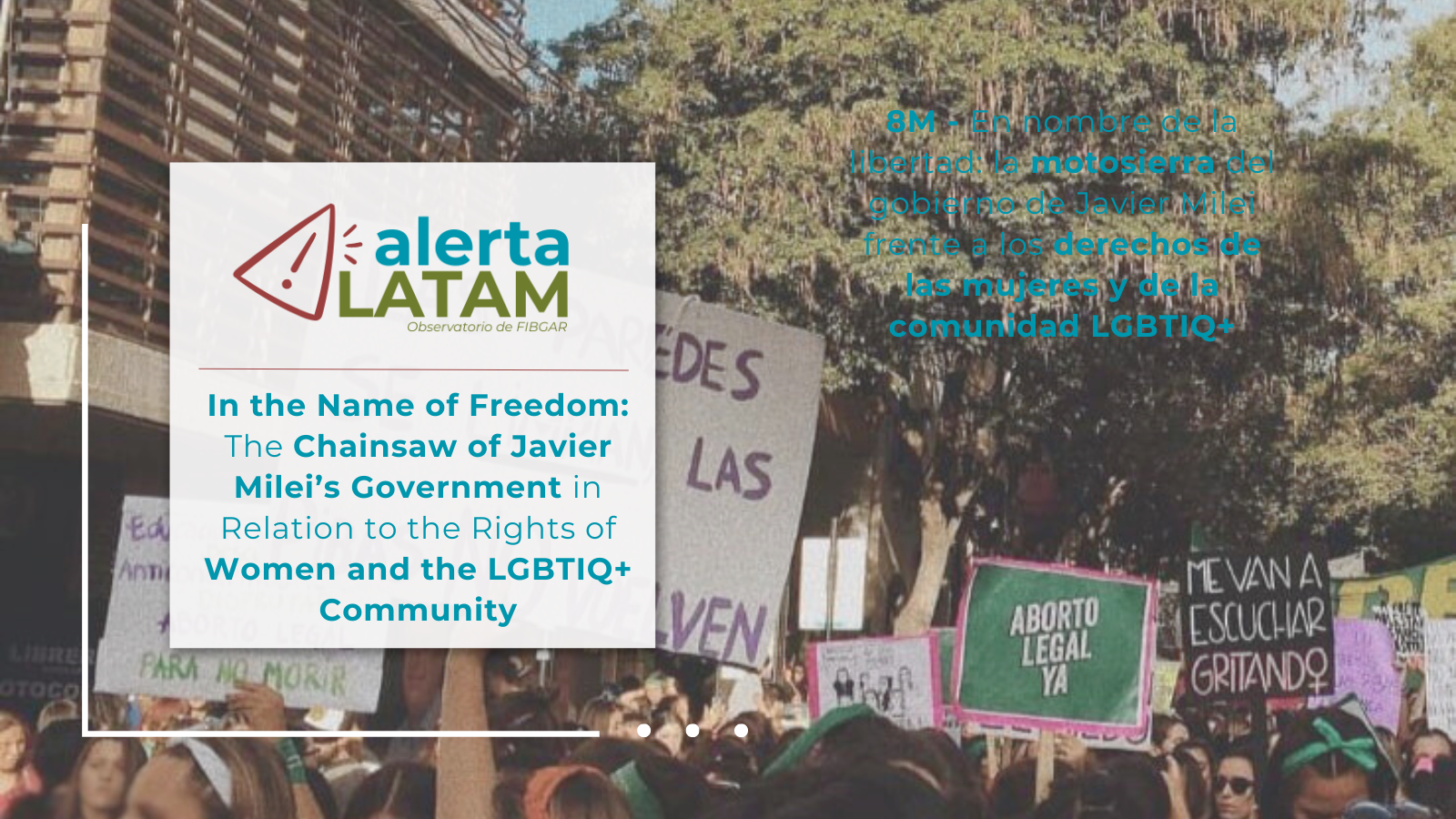
In the Name of Freedom: The Chainsaw of Javier Milei’s Government in Relation to the Rights of Women and the LGBTIQ+ Community
Since December 2023, in Milei’s Argentina, measures have been implemented that have undermined the quality of life and the rights of the population. Thus, under the justification that they constituted the only possible response to the crisis, this model imposed the pragmatism of economic relations over the promotion of democratic values and human rights.
In this context, women and persons belonging to the LGBTIQ+ community have been particularly affected by the “chainsaw”. Under the premise of eradicating “gender ideology”, the Government closed the Ministry of Women, Gender and Diversity—created in December 2019, during the presidential term of Alberto Fernández—whose functions were absorbed by other departments without their own structure or allocated budget. In this manner, a framework of nearly 40 years of public policies was dismantled, leaving tens of thousands of women and persons belonging to the LGBTIQ+ community without a support network in the face of violence and discrimination.
With the subsequent closure of the Undersecretariat for Protection against Gender-Based Violence—to which the Ministry of Women, Gender and Diversity had been reduced in June 2024—for the first time in 37 years the Argentine State no longer has a specialised national body dedicated to the promotion of the rights of women and identities belonging to the LGBTIQ+ community.
The offensive against public policies continued steadily throughout the libertarian administration. In this context, line 144 —created in 2009 during the first government of Cristina Fernández de Kirchner— which provided advice, support and referral in cases of gender-based violence 24 hours a day, 365 days a year, was absorbed by the Ministry of Justice, and the budget allocated to this area was reduced by 90%. The 2026 Budget Bill no longer includes a specific budget line, making it difficult to ascertain the resources assigned. According to statements by Minister Mariano Cúneo Libarona, the hotline would begin to provide advice to “all Argentinians who are in situations of violence and risk”, disregarding structural gender inequalities.
Likewise, in 2024 the budget allocated to the Acompañar Programme —which provides comprehensive support to women in situations of high-risk gender-based violence and assisted tens of thousands of persons in 2023— was reduced by 90% through under-execution of appropriations, and it ceased to appear as an identifiable budgetary item from the 2025 budget onwards.
Indeed, another of the areas dismantled within the framework of the restructuring of gender policies was the Acercar Derechos Programme (PAD), which operated under the former Ministry of Women, Gender and Diversity and facilitated comprehensive legal, psychological and social support to women and LGBTI+ persons in situations of gender-based violence, bringing access to justice closer to local communities. The Argentine Government, through the Ministry of Justice, also announced its definitive elimination in July 2025.
Although the Micaela Law No. 27.499, which mandates gender and gender-based violence training for all public officials across the Executive, Legislative and Judicial branches, remains in force, its implementation at the national level has been drastically undermined since December 2023. The coordinating unit was dissolved and almost all formal training and resources were cut, effectively paralysing the system. In response, several provinces and municipalities continued their programmes independently, leading to uneven application of the law nationwide.
As part of the so-called “cultural battle” promoted by the current administration against what it labels “gender indoctrination”, on 8 March 2024—the first International Women’s Day of Milei’s term—it was announced that the Hall of Argentine Women of the Bicentennial in the Casa Rosada would be renamed the “Hall of the Heroes”. According to the presidential spokesperson, Manuel Adorni, the decision was justified on the grounds that “having a Hall of Women may even be discriminatory for men.”
In the field of social security, the Government did not extend the pension moratoria, which expired on 23 March 2025 and had allowed access to a regularisation plan for contributions for those of retirement age who did not meet the required years due to informal work. Attempts by the Legislative Branch to reverse this were subsequently vetoed. While the measure affects the general population, its impact is disproportionate on women, who have lower labour force participation and higher informal employment rates, largely due to extended periods dedicated to unpaid care work or remunerated domestic work, often unregistered.
In education, the National Comprehensive Sexual Education (ESI) Programme received its lowest budget in years in 2024 and had no allocation in 2025. As a result, teacher training was halted and mandatory preventive programmes against violence in schools were eliminated, affecting the continuity and reach of gender equality and sexual rights education for students.
In healthcare, the implementation of Sexual and Reproductive Health Law No. 25.673 was no longer guaranteed. For over two decades, its application had reduced inter-jurisdictional disparities through centralised procurement of supplies, health team training and federal monitoring; currently, this system has been dismantled and responsibilities transferred to provincial jurisdictions without transition mechanisms.
Similarly, Law No. 27.610 on Voluntary Termination of Pregnancy, passed in December 2020 after prolonged struggle and which substantially improved access and safety for thousands of women, has also suffered under the current government’s dismantling policies. Since 2024, widespread shortages of misoprostol and mifepristone and a sharp decline in contraceptive distribution have been recorded. According to the latest report from the Proyecto Mirar, which monitors the implementation of this law, 106,737 medications were provided in 2023, while no national distribution occurred in 2024.
The National Plan for the Prevention of Unintended Adolescent Pregnancy (ENIA) has also been dismantled. Its 2025 budget was cut by 27% compared with the 2024 allocation and by 78% compared with 2023 actual expenditure. This programme had halved adolescent unintended pregnancies, and its weakening has increased maternal mortality and undermined preventive policies. In sexual and reproductive rights, the State asserts that access is primarily the responsibility of provinces, disregarding its non-delegable obligations of regulation, funding and territorial equality.
Normative and discursive setbacks affecting trans and non-binary persons have also been recorded amid rising violence and discrimination. In February 2024, inclusive language was prohibited in the public administration, aiming to exclude gender perspectives from state communication. Furthermore, under Executive Decree 61/2025, the Milei Government amended Article 11 of the Gender Identity Law No. 26.743 —passed in 2012 under Cristina Fernández de Kirchner— removing the right of persons under 18 to access comprehensive hormonal interventions to align their bodies with their self-perceived gender identity, without requiring judicial or administrative authorisation. This abrupt suspension of ongoing treatments gravely affects both the physical and mental health of trans adolescents in the process of self-identification.
In labour matters, numerous measures have reduced rights and protections, particularly affecting women and LGBTIQ+ identities, including the recently approved Labour Modernisation Law. These amendments disproportionately impact groups who assume the majority of care responsibilities and, according to the UN Women Country Profile Argentina 2024, face multiple barriers endangering their economic autonomy—including lower labour force participation, unemployment, informal work, overrepresentation in low-income feminised sectors—and constitute the majority of persons in poverty and extreme poverty in the country. In addition, the law removes the right to prior notice for women employed in domestic work.
These measures directly impact millions of people and contravene numerous international and national laws. Nationally, Law No. 26.485 on Comprehensive Protection Against Gender-Based Violence mandates that the Executive have a governing body to prevent, punish and eradicate gender-based violence, alongside other guarantees and preventive obligations. Internationally, the Convention on the Elimination of All Forms of Discrimination Against Women (CEDAW), ratified by Argentina in 1985, and the Inter-American Convention on the Prevention, Punishment and Eradication of Violence Against Women (“Belém do Pará”), both constitutionally ranked, have been widely violated by the national government.
It is evident that in a country where, according to the Lucía Pérez Observatory, 273 femicides and transfemicides were recorded in 2025 —mostly in contexts with prior reports of violence— state policies neither guarantee effective protection nor acknowledge the problem. On the contrary, the official narrative denies gender-based violence and seeks to eliminate gains achieved over recent years, aligning internal policies with the highest international human rights standards. By attacking public institutions and asserting that “violence has no gender”, the government has legitimised violence as part of the political agenda.
This official rhetoric has permeated social life, reshaping perceived “common sense” and granting the government legitimacy to oppose human rights policies in general, and gender and diversity policies in particular.
In this framework, the government has consolidated the dismantling initiated just over two years ago, a logic reflected in the 2026 Budget Bill, which proposes severe cuts to gender equality, violence prevention, sexual and reproductive health, and comprehensive sexual education—approximately only 2% of resources allocated in 2023.
In this context, Argentina was recently evaluated by the United Nations Committee on the Elimination of Discrimination Against Women —tasked with monitoring CEDAW compliance— regarding obligations on preventing gender-based violence, eradicating structural discrimination, and ensuring access to sexual and reproductive health. The State submitted supplementary information in December 2023, citing legal frameworks and formal mechanisms but omitting details of budget cuts or reforms enacted over the previous two years, which were merely described as “reorderings” or “changes in approach”. In response, numerous civil society organisations submitted alternative reports, contrasting official data with empirical evidence and field experience, highlighting deliberate setbacks, defunding and institutional hollowing-out of gender and diversity bodies, which limit effective implementation of CEDAW rights.
During the Committee session, commissioners posed extensive questions to the Argentine delegation, expressing concern over civil society reports. However, the State, rather than engaging with this evidence, maintained a formalistic and restrictive view of equality, rejecting positive action and the substantive equality framework underpinning the Convention, explicitly dismissing the “gender perspective” and the concept of “intersectionality”; it adopted a regressive stance on sexual and reproductive rights, insisting that the State should defer to families; prioritised a punitive approach while minimising comprehensive and preventive policy needs; denied institutional dismantling, budget reductions and any regression in rights. Collectively, the official responses revealed a restrictive interpretation of CEDAW and a failure to align with standards developed by the Committee itself.
The words of Simone de Beauvoir resonate with unsettling force in Argentine politics today: “A political, economic or religious crisis will suffice for women’s rights to be questioned once again.” In the current context —marked by a profound economic crisis and an ideological shift that relativises and denies structural inequalities— this warning is undeniable. Far from abstract, recent experience demonstrates how fragile gender equality gains can become when the State abandons or consciously attacks its responsibility to guarantee them.
In short, what is happening in Argentina under Javier Milei cannot be read as mere administrative reorganisation or simple “changes in approach”. It is a sustained process of institutional dismantling and regression in gender and diversity policies, directly affecting the daily lives of millions of women and LGBTIQ+ persons, whose quality of life has deteriorated markedly over two years. The combination of budgetary cuts, discursive denial of structural inequalities, and weakening of public policies not only contravenes international commitments but erodes the very foundations of a democracy based on substantive equality.
Against this backdrop, the normalisation of these setbacks and attempts to redefine achieved rights as ideological privileges is deeply concerning. What is at stake is not a rhetorical dispute, but the effective guarantee of minimum conditions of equality, dignity, autonomy and protection from violence. It is therefore essential to demand that the Argentine State halt this regressive trajectory, restore protective mechanisms, and fulfil its constitutional and international obligations. Failure to do so consolidates a model that deepens historical inequalities and leaves large sectors of the population in a state of greater vulnerability and defenselessness.
Federica Carnevale, Project Manager, FIBGAR
REFERENCES
BBC News Mundo. (2026, 27 January). How Argentina has changed under the government of Javier Milei: Key points and controversies. Available at: https://www.bbc.com/mundo/articles/c72key7z4j3o
Efeminista. (2025, 22 October). 2026 Budget and gender in Argentina: Analysis and consequences. Available at: https://efeminista.com/presupuesto-2026-milei-genero/
ELA – Latin American Team for Justice and Gender. (2025). Argentina before the CEDAW Committee: Between the official narrative and setbacks in the rights of girls, adolescents, and women in all their diversity. Available at: https://ela.org.ar/novedades/argentina-ante-el-comite-cedaw-entre-el-relato-oficial-y-los-retrocesos-en-los-derechos-de-ninas-adolescentes-y-mujeres-en-toda-su-diversidad/
Presentes Agency. (2026, 19 February). Labour reform: How it affects women and diverse identities. Available at: https://agenciapresentes.org/2026/02/19/reforma-laboral-como-afecta-a-mujeres-y-diversidades/
Presentes Agency. (2025, 6 February). Milei modified the Gender Identity Law by decree: What changed and why judicial intervention is requested. Available at: https://agenciapresentes.org/2025/02/06/milei-modifico-por-decreto-la-ley-de-identidad-de-genero-que-cambio-y-por-que-piden-intervenga-la-justicia/
UN Women. (2025, April). UN Women presents the Argentina Country Profile 2024: Report on inequalities between women and men. Available at: https://lac.unwomen.org/es/stories/noticia/2025/04/onu-mujeres-presenta-el-perfil-de-pais-argentina-2024-informe-sobre-desigualdades-entre-mujeres-y-hombres
