


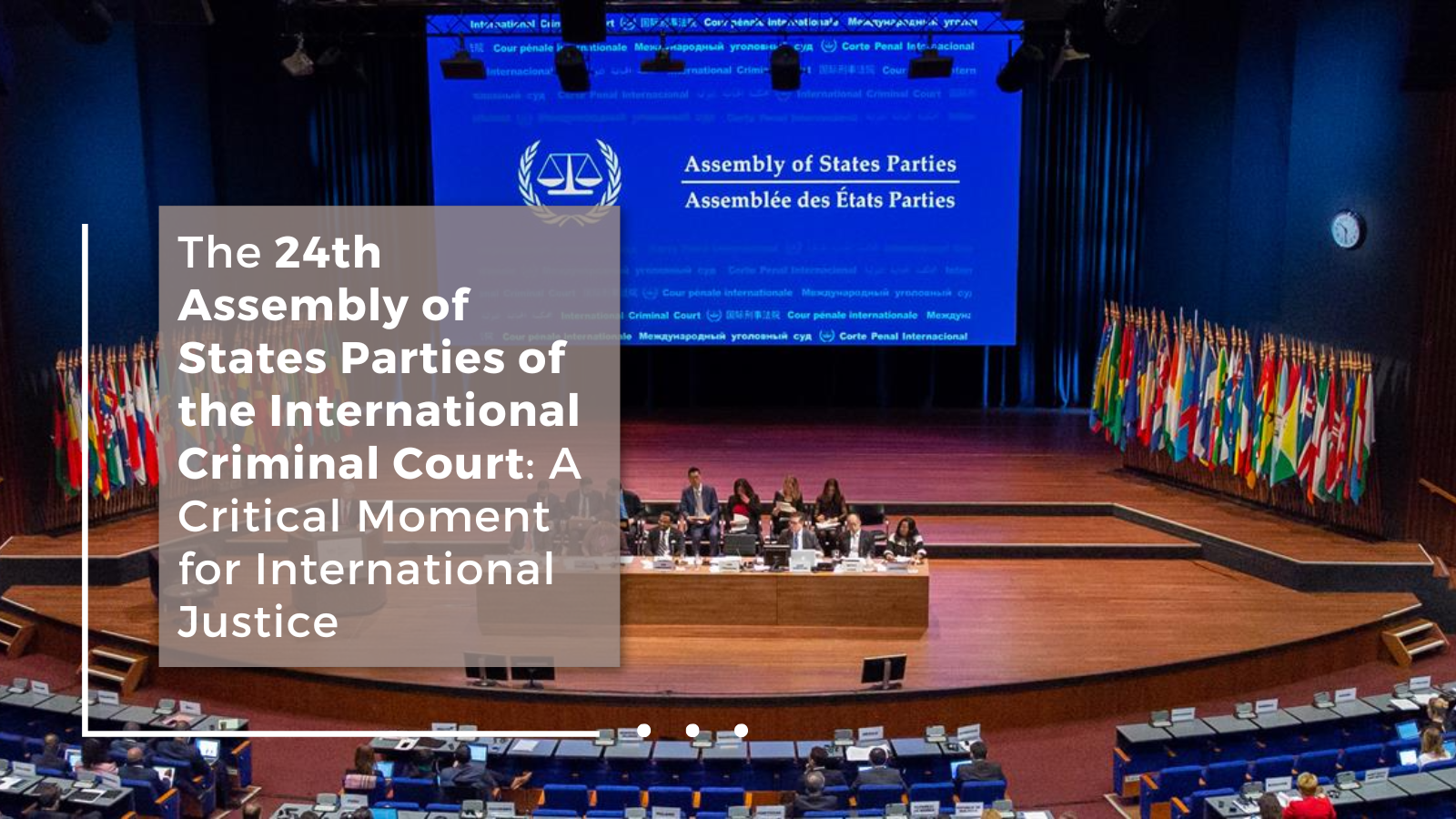
The 24th Assembly of States Parties of the International Criminal Court: A Critical Moment for International Justice
This week, the 24th Assembly of States Parties of the International Criminal Court (ICC) is taking place in The Hague, Netherlands, from December 1 to 6, 2025. This annual gathering represents a decisive moment for the administrative and legislative oversight of the Court, bringing together all States that have ratified or acceded to the Rome Statute to make decisions on issues essential to the functioning and credibility of the ICC.
The Assembly of States Parties, more than a formal deliberative body, acts as a guarantor of the Court’s institutional stability. Its agenda covers everything from the election of officials to the approval of the annual budget, as well as discussions on State cooperation and non-cooperation, the complementarity of the international justice system, and potential amendments to the Rome Statute and other rules. Every decision taken during the Assembly has a direct impact on the ICC’s ability to fulfill its mandate to prosecute the most serious international crimes and ensure that impunity does not prevail.
The context in which this year’s Assembly is taking place is particularly challenging. Over the past year, the Court has faced growing political and diplomatic pressures, including threats and coercive measures against its officials, which pose a serious risk to the administration of international justice and the global fight against impunity. Notably, sanctions imposed by the United States against ICC prosecutors and judges, along with the threat of further sanctions, underscore the vulnerability of the Court to political interests seeking to undermine its independence.
On November 11, 2025, ICC President Judge Tomoko Akane presented the Court’s annual report to the United Nations General Assembly in New York. In her address, President Akane highlighted the challenges faced by the Court over the past year, emphasizing that sanctions against senior officials not only hinder the ICC’s work but also affect the broader international legal order. According to Judge Akane, the Court’s ability to carry out its mission of delivering justice cannot be compromised by external pressures, and the international community must ensure that judicial independence is fully respected.
The lack of cooperation from certain States Parties has also been a significant challenge. Recently, Tajikistan failed to comply with arrest warrants issued by the Court regarding alleged crimes committed by Russian President Vladimir Putin in the context of the war in Ukraine. Additionally, ICC judges determined that Italy failed to meet its cooperation obligations when it arrested and subsequently released Al-Masri Njeem, suspected of war crimes and crimes against humanity in Libya. These cases demonstrate that the Court’s effectiveness relies directly on States’ willingness to cooperate with investigations and comply with their international responsibilities, and that the ICC’s independence cannot be guaranteed by diplomatic statements alone.
In her UN address, Judge Akane offered a stark reminder of the fragility of the international project built during the twentieth century. She emphasized that even a momentary lapse in the international community’s commitment can have a negative impact on decades of work aimed at consolidating the rule of law worldwide. Despite these challenges, the ICC remains committed to justice, ensuring individual accountability for international crimes and acting with full independence and impartiality. In doing so, the Court seeks to strengthen the rule of law within the international community and provide effective judicial responses where national systems are unable or unwilling to act.
The 24th Assembly of States Parties represents a critical opportunity to reaffirm States’ support for the ICC’s independence and the importance of the Rome Statute. However, formal affirmations alone are not sufficient. The ICC requires tangible political and financial backing to ensure the continuity of its investigations, the enforcement of arrest warrants, and the protection of its officials from external threats. Solidarity with the Court must translate into concrete actions that allow it to fulfill its mandate without interference.
In this context, the Coalition for the ICC, of which FIBGAR is a member, has issued an urgent call to States Parties and all members of the UN General Assembly to reinforce their commitment to the Court. This includes ensuring that the ICC can continue its work independently and without obstruction, that States comply with their cooperation obligations, and that the Court receives the necessary funding to operate effectively and sustainably. Protecting the ICC’s independence is not merely an institutional concern; it is a global imperative for upholding the rule of law and preventing impunity.
The ICC’s relevance extends beyond legal frameworks: it serves as a cornerstone of international justice, providing accountability where national systems fail and sending a clear message about responsibility for the most serious crimes. The challenges facing the Court reflect the tensions inherent in the international system, where political and geopolitical interests can jeopardize decades of progress. Therefore, this year’s Assembly must focus not only on internal administration and management but also on reaffirming, through concrete decisions, the collective commitment to a strong, independent, and effective international justice system.
Ultimately, this year’s Assembly occurs at a moment of utmost significance. The international community has an opportunity to demonstrate its genuine commitment to global justice and to consolidate the ICC as a key instrument against impunity. The Court’s work, from investigations to trials of individuals responsible for international crimes, represents a unique effort that requires cooperation and sustained support from all States Parties. Only through such effective backing can international justice fulfill its mission of protecting human rights and strengthening the international legal order for the benefit of all humanity.
