

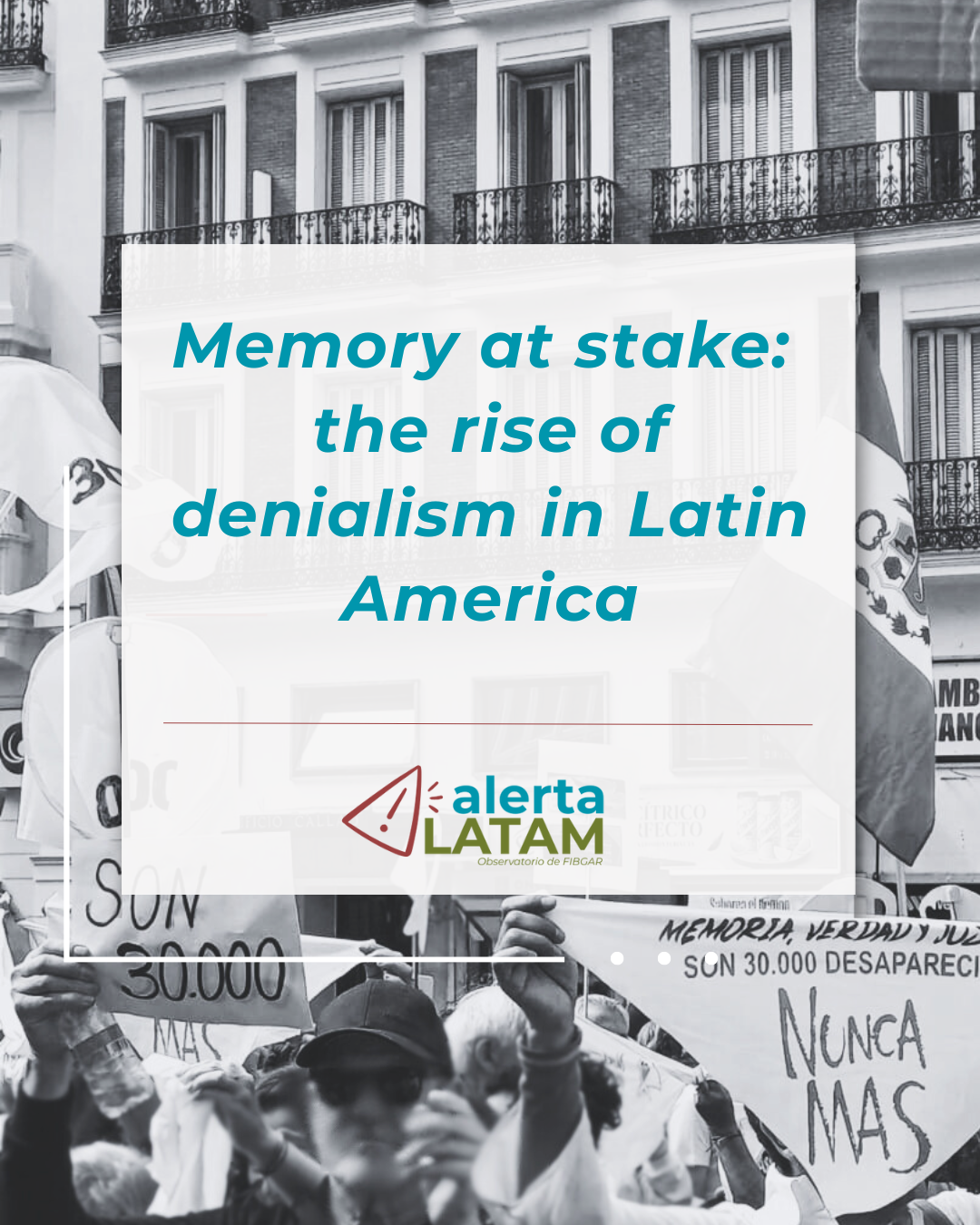
Memory at Stake: the Rise of Denialism in Latin America
Latin America is a region that has long carried unresolved historical wounds. With regard to its recent history, the twentieth century was marked by military coups, armed conflict, enforced disappearances and multiple violations of human rights. In particular, during this period repression reached an extreme level of cruelty under the dictatorships that emerged in the 1970s, leaving a number of victims that, to this day, has not been fully established.
This political repression—characterised by enforced disappearances, torture, arbitrary detention and extrajudicial executions, the appropriation of infants, and systematic secrecy—which unfolded under the dictatorships of each Latin American country, acquired a particularly sinister regional dimension with the creation of Operation Condor. From 1975 onwards, and with the economic and military support of the United States, military intelligence officials from the regimes of Argentina, Bolivia, Chile, Paraguay and Uruguay, following a series of meetings, established—under the justification of a struggle against internal enemies and communist subversion, and inspired by the United States’ National Security Doctrine—a transnational system of repressive cooperation. This system enabled the coordination of clandestine operations to locate, monitor, abduct, torture and assassinate exiled individuals who continued to denounce the regimes from abroad, as well as relatives of disappeared persons and refugees identified as threats by the repressive apparatuses. Brazil would later join in 1976, followed by Ecuador and Peru in 1978.
Following the fall of the dictatorial regimes in Latin America, the region became part of a global process of democratisation that resulted in the twentieth century ending with the highest number of democratic states the world had ever seen. Latin American societies embraced demands for memory, truth, justice, reparation and guarantees of non-repetition, giving rise to historically significant processes. Some of the countries that had suffered under this systematic plan of repression, such as Argentina, even brought the perpetrators of genocide before ordinary courts of justice. This led to the conviction and imprisonment in 1985 of the senior leadership of the Military Juntas of the three branches of the armed forces (Army, Navy and Air Force) that headed these regimes, and to the continued prosecution of those responsible to this day.
This cycle, which once appeared irreversible, is now being eroded. We are currently experiencing a democratic recession, a trend observable at the global level, and alongside the contemporary questioning of democracy itself, other consensuses reached during the latter half of the twentieth century are also being challenged. Latin America—a region navigating its first decades of redemocratisation following the last wave of authoritarian regression in the 1960s and 1970s—has not escaped this trend at the dawn of the new century. In recent years, the region has witnessed a systematic decline in public support for democratic regimes and values, alongside a steady rise in indifference towards more authoritarian models.
The Argentine case, marked by the rise of Javier Milei’s government at the end of 2023, may constitute one of the most recent examples of these dynamics. Thus, forty years after the Trial of the Juntas, denialism is gaining momentum in Argentina. For several years now, and with increasing intensity, not only have the most horrific crimes committed by the perpetrators of genocide been denied, but victims have also been discursively transformed into perpetrators. Even during the presidential campaign, senior figures within the governing party engaged in deeply troubling denialist rhetoric, questioning the number of victims of the dictatorship and reviving the so-called “theory of the two demons” as a means of justifying enforced disappearances during the period, with the aim of refounding the official memory of the dictatorship and contesting the social consensus rejecting state terrorism. Under the new government, revisionism and the vindication of crimes against humanity committed during the last military dictatorship have been placed at the centre of public debate. This constitutes a clear state practice aimed at undermining policies of memory, truth and justice, seeking to erode the agreements sustained over recent decades. The dismantling of the state is felt particularly acutely in these areas, which appears to be ideologically understood as a governmental decision intended to reverse this process.
The Argentine case is compounded by that of another country which, having suffered the devastating consequences of Operation Condor and a recent dictatorship, has elected a declared defender of Pinochet’s regime. Neighbouring Chile will have, from 2026 onwards, for the first time since the return to democracy, a president who openly vindicates the dictatorial past and did not hesitate to state that, were Augusto Pinochet alive, he would vote for him. The fact that this figure has become the most-voted presidential candidate in the history of the Andean country clearly demonstrates that memory itself is being placed at stake across the Southern Cone.
Moreover, in these countries, state denialism is increasingly complemented by an academic form of denialism which, under the guise of a spurious historical revisionism aimed at “telling the whole story”, seeks to disseminate a counter-narrative that legitimises state violence.
These public narratives, promoted by right-wing governments across the region, dangerously distort the past. Their purpose is the construction of power through the redefinition of the field of meaning, by contesting the interpretation of recent history. Denialism provides an effective repertoire for these groups, who employ it as part of their political strategies to build a new cultural hegemony. As the Italian philosopher Donatella Di Cesare notes (If Auschwitz Is Nothing: Against Denialism), their aim is not merely to deny the existence of an official history, but to transform democratic memory itself: they seek to discredit the reality of grave crimes committed and to construct a parallel or alternative history. In this way, the manipulation of memory—closely intertwined with the manipulation of factual reality experienced in many contemporary societies—is becoming a weapon even more dangerous than oblivion itself.
Policies of memory, truth, justice and reparation, together with measures guaranteeing non-repetition, are essential pillars for the consolidation of more just democracies. It is therefore imperative to issue a call not to abandon these struggles, but rather to deepen the processes of social reconstruction necessary to ensure that such atrocious crimes are never repeated. Despite the denialism projected by certain actors, the struggle of survivors, families and human rights organisations, and the pursuit of memory, truth and justice, must continue—stronger and more vital than ever.
Federica Carnevale, Project Officer.
REFERENCES
Agenda Estado de Derecho, Discursos negacionistas y derechos humanos en Latinoamérica: ¿nunca más? [Denialist Discourses and Human Rights in Latin America: Never Again?], 11 September 2023, available at: https://agendaestadodederecho.com/discursos-negacionistas-y-derechos-humanos-en-latinoamerica-nunca-mas/
Soto Carmona, Álvaro, “Las amenazas a la democracia” [Threats to Democracy], in Alcores, Issue No. 24, 2020, ISSN: 1886-8770, Universidad Autónoma de Madrid, 15 November 2020.
Asociación Abuelas de Plaza de Mayo, Press Release, “Plan de impunidad para condenados por delitos de lesa humanidad: pedimos explicaciones al Consejo de la Magistratura” [Impunity Plan for Those Convicted of Crimes against Humanity: We Demand Explanations from the Council of the Judiciary], 15 August 2024, available at: https://www.abuelas.org.ar/prensa-y-difusion/noticias/1965
Vallespín, Fernando, “La transformación del Estado como consecuencia de la crisis económica” [The Transformation of the State as a Consequence of the Economic Crisis], Revista CLAD Reforma y Democracia, No. 48, 2010.
Gentile, Emilio, La vía italiana al totalitarismo. Partido y Estado en el régimen fascista [The Italian Road to Totalitarianism: Party and State in the Fascist Regime], Siglo XXI Editores, Argentina, 2005.
Perelman, Marcela, “Memoria: el año en el que el pasado se hizo presente” [Memory: The Year in Which the Past Became Present], in Anuario 2024: Milei, Centro de Estudios Legales y Sociales (CELS), Buenos Aires, available at: https://cels.org.ar/anuarioultraderecha/memoria/
