


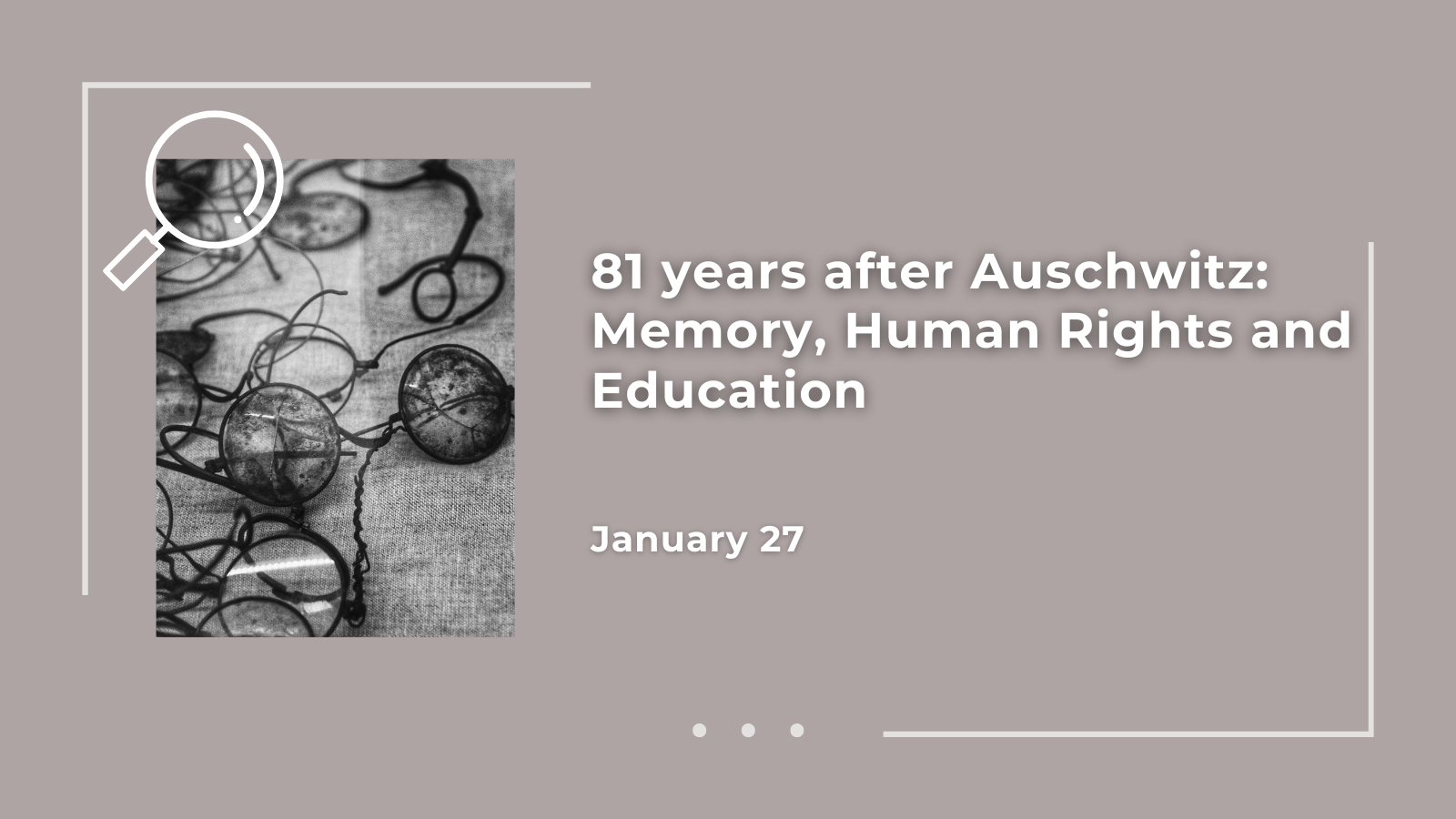
81 years after Auschwitz: Memory, Human Rights and Education
In November 2005, the United Nations General Assembly officially proclaimed 27 January as the International Day of Commemoration in Memory of the Victims of the Holocaust through Resolution 60/7. Since then, the international community has recognized this date as a space for commemoration, reflection, and education, aimed not only at honouring the victims but also at preventing the recurrence of atrocious crimes.
Each year on 27 January, UNESCO pays tribute to the memory of the victims of the Holocaust and reaffirms its commitment to combating antisemitism, racism, and all forms of intolerance that may give rise to violence against specific groups. This date commemorates the liberation in 1945 of the Nazi German concentration and extermination camp of Auschwitz-Birkenau, one of the most extreme symbols of the genocide perpetrated by the Nazi regime during the Second World War.
On 27 January 2026, the 81st anniversary of the liberation of Auschwitz-Birkenau will be commemorated. In this complex, more than one million people were murdered, most of them Jews, as well as other victims persecuted on ethnic, political, religious, sexual orientation, or disability grounds. On this anniversary, UNESCO will organize a series of events and activities to underscore the importance of teaching and learning about the Holocaust, particularly in a context marked by the rise of antisemitism and hate speech.
Educating about the Holocaust entails analysing its causes, dynamics, and consequences, as well as creating counter-narratives for new generations in the face of ideologies of hatred, exclusion, and dehumanization. This task is especially relevant in a world in which genocides and other atrocities continue to occur.
In this context, UNESCO plays a central role through initiatives such as Holocaust and genocide education, the International Programme on Holocaust and Genocide Education, developed in cooperation with the United States Holocaust Memorial Museum, the dissemination of essential historical information, and documentary preservation through the Memory of the World Programme.
A key element of Holocaust memory is judicial accountability. Following the end of the Second World War, the Nuremberg Trials (1945–1946) set a historic precedent by prosecuting leading figures of the Nazi regime for war crimes, crimes against humanity, and crimes against peace. These trials affirmed that atrocity crimes cannot go unpunished, established fundamental principles of international criminal law, and directly contributed to the subsequent development of the international human rights system. The contemporary relevance of Nuremberg has also recently been revived in the cultural sphere with the release of the film Nuremberg (2025), which reconstructs the legal, political, and moral dilemmas of those proceedings and highlights their legacy for contemporary international justice. Cinema, as a tool of memory, thus helps bring these debates closer to new generations and reinforces the idea that justice and accountability are essential pillars of non-repetition.
The experience of Nuremberg contrasts significantly with the Spanish case. Following the Civil War and the Franco dictatorship, Spain did not conduct comparable judicial proceedings to investigate, prosecute, and punish crimes committed by the regime. The adoption of the 1977 Amnesty Law consolidated a model of transition based on forgetting and impunity, preventing victims for decades from accessing truth, justice, and reparation. This absence of judicial accountability has profoundly shaped memory politics in Spain and remains the subject of ongoing debate.
Resolution 60/7 not only established the International Day of Commemoration in Memory of the Victims of the Holocaust but also explicitly rejected any form of Holocaust denial. It further called upon States to actively preserve sites used by the Nazis during the “Final Solution,” such as extermination camps, concentration camps, and prisons. This resolution is grounded in the principles of the Universal Declaration of Human Rights, which condemns religious intolerance, harassment, and violence based on ethnic origin or beliefs.
Official commemorations began on 27 January 2006 at United Nations Headquarters in New York and have since been held annually around the world. From 2010 onwards, the UN has selected specific annual themes, addressing issues such as Holocaust survivors, the experiences of women, childhood, those who risked their lives to save others, and the relationship between the Holocaust, the UN Charter, and the Universal Declaration of Human Rights.
During the Nazi period, hundreds of thousands of people were forcibly displaced. It is estimated that more than 355,000 Jews and Germans left their homes due to persecution, and tens of thousands sought refuge in Latin American countries or in destinations such as Shanghai. These stories of exile and survival form an important part of Holocaust memory.
As recalled by UN Secretary-General António Guterres, intolerance “feeds on anger and anxiety in a changing world.” In response, education and historical memory remain fundamental tools for protecting universal values, human dignity, and human rights. The experience of Nuremberg demonstrates that it is possible to prosecute the gravest crimes and lay the foundations of international law, while the absence of similar processes in other contexts, such as Spain, reveals the democratic costs of impunity. Remembering, educating, and ensuring justice are not symbolic acts, but fundamental obligations for the defence of human rights and for preventing history from repeating itself.
Marina de Leiva Álvarez, collaborator at FIBGAR
