


FIBGAR launches “Voices in Motion” with a debate on the criminalisation of critical voices, SLAPPs and lawfare in Latin America
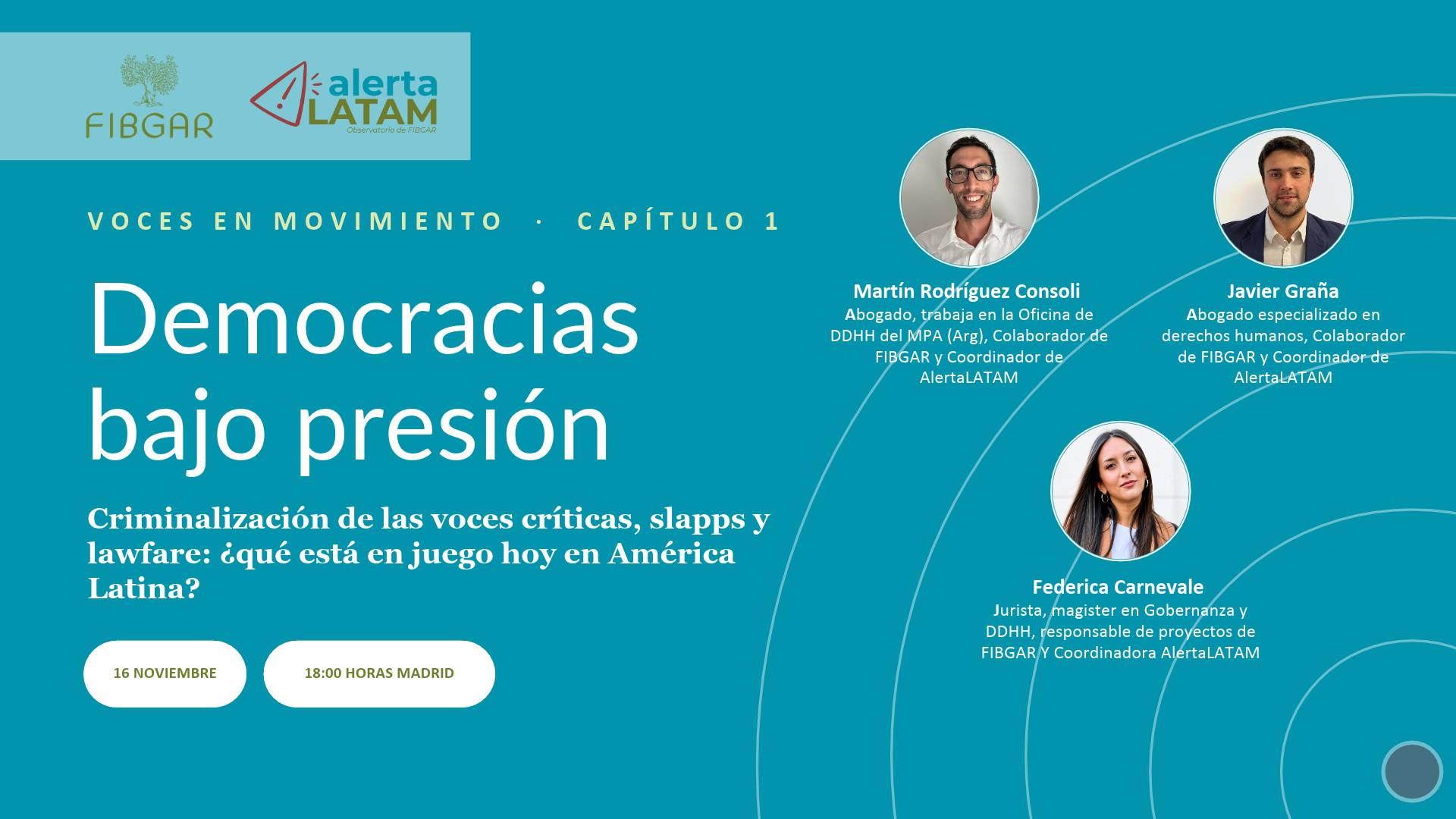
The International Foundation Baltasar Garzón (FIBGAR), through its Alerta LATAM Observatory, held the first event in the “Voices in Motion” webinar series, an initiative designed to create spaces for dialogue and exchange on the main democratic and human rights challenges in Latin America. Under the title “Democratic Alert: Criminalisation of Critical Voices, SLAPPs and Lawfare: What Is at Stake in Latin America Today?”, the webinar brought together Federica Carnevale, Javier Graña and Martín Consoli, members of the Observatory, to address different forms of instrumentalisation of the judicial system and their consequences for public participation, democracy and the rule of law.
The event also provided an opportunity to present the objectives of the Alerta LATAM Observatory and explain the purpose of this new series of conversations. The initiative seeks to connect experiences from different countries in the region, bring shared challenges to light and bring into public debate the perspectives of young professionals working in areas such as research, litigation, communication and human rights advocacy. Through five thematic meetings, Voices in Motion aims to offer a regional, pluralistic and accessible perspective on issues affecting democracy and human rights in Latin America.
The first presentation was delivered by Federica Carnevale –human rights lawyer, FIBGAR Project Manager and coordinator of the Alerta LATAM Observatory– who introduced the general framework for the discussion and explained why lawfare, SLAPPs and the criminalisation of critical voices are particularly relevant phenomena for analysing the region’s democratic situation. In this regard, she noted that the weakening of contemporary democracies does not always take the form of abrupt ruptures in the constitutional order, such as the coups d’état of the past, but can occur gradually through institutional erosion, the concentration of power and the weakening of oversight and accountability mechanisms. In certain contexts, institutions designed to protect people’s rights and limit the exercise of power can be instrumentalised and turned into tools that undermine democracy from within.
Building on this assessment, she focused her presentation on lawfare, or judicial warfare, understood as the strategic instrumentalisation of the legal system and judicial proceedings for political purposes, generally accompanied by media persecution. She warned that these practices can be used to sideline or neutralise political opponents, influence electoral processes and shape countries’ political, economic and social agendas. Their consequences directly affect essential principles of constitutional democracies, such as the separation of powers, judicial independence, due process and the rule of law. She also stressed that, although these dynamics are not exclusive to Latin America, they take on particular characteristics in the region and must be analysed in light of their historical and political contexts.
At this point, she also focused on the transformation of forms of political persecution in Latin America. While for much of the twentieth century repression against opposition movements was carried out through military dictatorships, arbitrary detention, torture and enforced disappearances, recent decades have seen the growing relevance of mechanisms operating under the guise of institutional legitimacy. The instrumental use of judicial proceedings can thus become a means of removing certain actors from popular political life, weakening alternative political projects and conditioning the functioning of democratic institutions. This transformation does not mean that repressive practices have disappeared, but rather that they have adapted to new scenarios and tools of power. It is therefore necessary to consider not only the formal legality of proceedings, but also their purposes, contexts and effects.
Javier Graña –human rights lawyer, FIBGAR collaborator and coordinator of the Alerta LATAM Observatory– then addressed strategic lawsuits against public participation, known as SLAPPs (Strategic Lawsuits Against Public Participation). To introduce the phenomenon, he posed a central question: what happens when participating, reporting, investigating or questioning those in power can become grounds for facing legal proceedings? In response, he explained that SLAPPs are legal actions brought with the aim of intimidating, exhausting or silencing those who engage in matters of public interest. They affect not only journalists, human rights defenders, civil society organisations and activists, but also pose a problem for the quality of democracy and the conditions in which public debate takes place. In this regard, he recalled the regional study promoted by FIBGAR, which examined these practices in eleven Latin American countries, identifying common patterns, reviewing existing legal frameworks and analysing specific cases.
He also placed particular emphasis on the chilling effects of these lawsuits. Beyond the economic, personal and professional consequences faced by defendants, SLAPPs have a deterrent effect on third parties who, witnessing legal retaliation against those who report matters of public interest, may choose not to investigate, publish or speak out. This self-censorship effect is particularly worrying where there are significant resource imbalances between those bringing the lawsuits and those required to defend themselves. He therefore highlighted the need to develop legislative and jurisprudential responses that make it possible to identify these practices and provide appropriate protection mechanisms. General guarantees of freedom of expression are not enough: judicial systems and their practitioners must be able to recognise when an action brought under the guise of legality is, in fact, intended to restrict public participation.
The final presentation was delivered by Martín Consoli –lawyer, FIBGAR collaborator and coordinator of the Alerta LATAM Observatory– who explored the patterns identified in the regional study and the legal responses that could help prevent and combat SLAPPs. First, he noted that these lawsuits should be understood as abusive actions aimed at restricting public participation and freedom of expression. He also warned that this is not a phenomenon confined to any one political or institutional context: it can arise in countries with very different democratic and institutional trajectories and may be brought by both private actors –such as companies or individuals with significant economic power– and public actors. Among its consequences, he highlighted the fragmentation of collective participation and the displacement of people from public spaces. In this regard, he returned to a central idea of the meeting: when judicial proceedings themselves become a form of punishment, the cost of mounting a defence can ultimately become a way of silencing criticism, even when the lawsuit is unsuccessful.
He also reviewed some of the legislative progress and challenges in Latin America. Among other examples, he referred to legislative initiatives in Colombia that did not complete the parliamentary process, as well as jurisprudential developments in countries such as Argentina and Brazil and initiatives promoted in Paraguay on the basis of standards established by the Inter-American Court of Human Rights. Against this uneven backdrop, he highlighted the importance of developing specific legal tools, including the possibility of dismissing abusive lawsuits at an early stage, preventing those affected from having to endure lengthy proceedings and establishing consequences for those who use the courts for intimidatory purposes. He also stressed the need to strengthen the training of justice sector professionals and move towards legal frameworks that protect public participation in its various forms: from journalism and research to demonstrations, publications, social media and the activities of civil society organisations.
The three presentations addressed, from complementary perspectives, the different ways in which the law and judicial institutions can be instrumentalised to restrict democratic space. Both lawfare and SLAPPs show that the formal existence of institutions and legal procedures does not, in itself, guarantee respect for democratic principles: it is also necessary to ensure their independence, their lawful use and their ability to protect those who participate in public affairs.
The event highlighted the need to continue creating spaces for analysis and dialogue that help us understand the different ways in which human rights and democratic institutions are affected in Latin America. Through “Voices in Motion”, FIBGAR and the Alerta LATAM Observatory seek to continue these discussions, bring together experiences and perspectives from different contexts, and promote a regional approach that helps identify common challenges, recognise lessons learned and explore possible collective responses.
To watch the full webinar, visit FIBGAR’s YouTube channel and access the recording of the event: https://www.youtube.com/watch?v=xLYr5O1BMSA
