


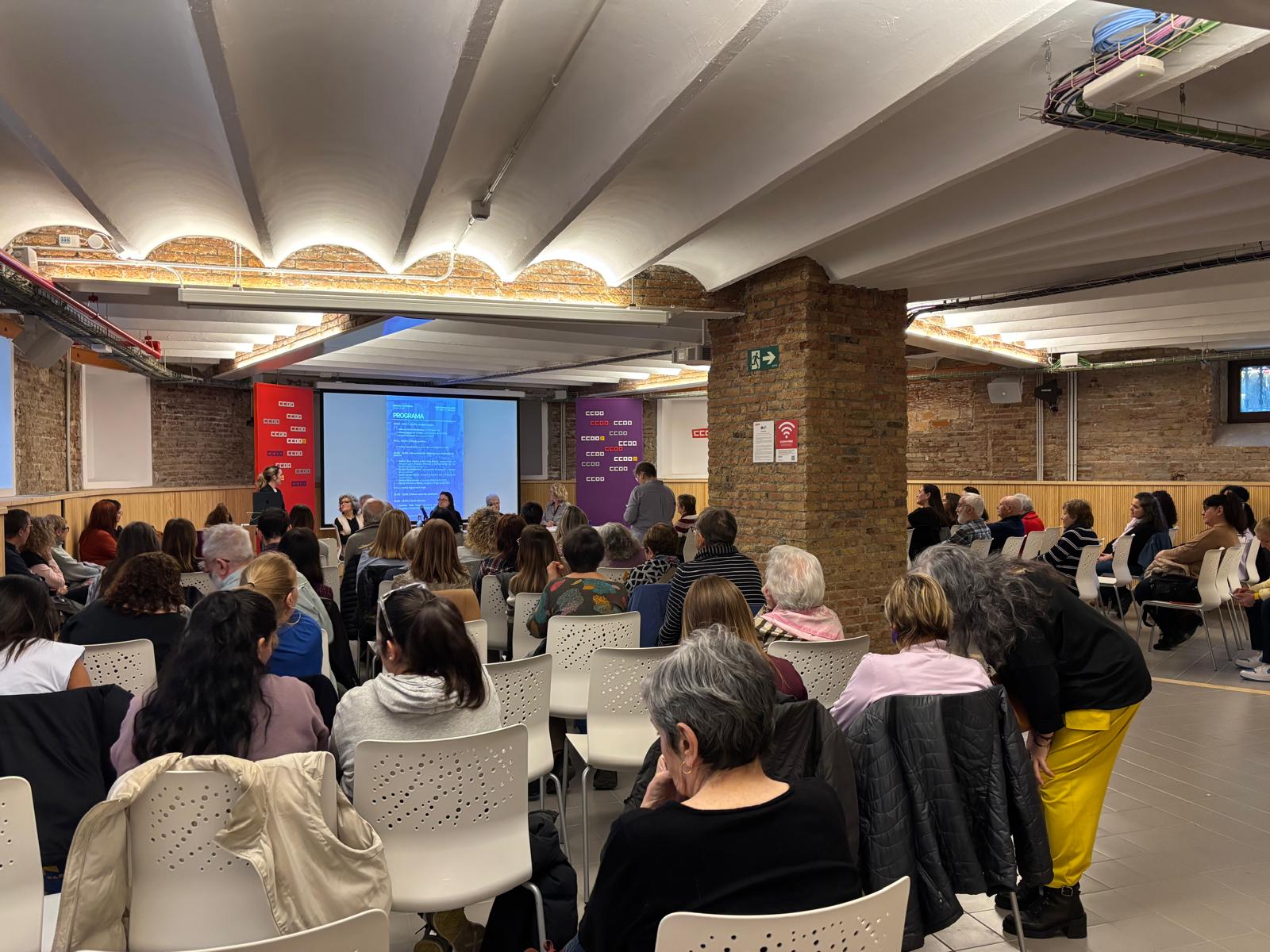
FIBGAR held the event ‘Women defending democracy: A feminist perspective on access to justice and democratic memory’ as part of the Women’s Network for Memory and Democracy (REDMEM).
On Friday 27 February, the first event of the year took place within the framework of the Women’s Network for Memory and Democracy (REDMEM), organised together with Comisiones Obreras de Catalunya and in collaboration with the Catalan Association of Former Political Prisoners of Francoism.
The conference, held in CCOO Catalunya headquarters located in Via Laietana (Barcelona), was entitled ‘Women defending democracy: A feminist perspective on access to justice and democratic memory’, and it was part of the 70th session of the United Nations Commission on the Status of Women, which this year focuses on access to justice for women and girls.
The event therefore aimed to bring together a diverse group of women with one thing in common: the lack of access to justice and procedural guarantees during the Franco regime and the transition to democracy, which still persists today.
The event was opened by Belén López Sánchez, General Secretary of CCOO Catalonia, who reflected on the importance of the role of women trade unionists in the fight for women’s rights; Nadia Gayoso de la Calle, coordinator of REDMEM, explained to attendees why it became necessary to create the Network of Women for Memory and Democracy; and Alessia Schiavon, director of the Baltasar Garzón International Foundation (FIBGAR), helped to contextualise the event under the umbrella of the Commission on the Status of Women.
After the welcome, Esther Lázaro Sanz and Rosa Aguado Rosique, from the Therkas Teatre company, performed a dramatised reading of an excerpt from the play ‘Las huellas del silencio’ (The Footprints of Silence), which helped to contextualise part of the problem of forced disappearances of children during the Franco dictatorship and the transition to democracy.
Later, a round table discussion entitled ‘Women in the fight for justice’ was held, in which five women gave their testimonies regarding access to justice based on their own experiences. Adelina Ruiz Santos and Ana Paez Garros, from SOS Bebés Robados de Catalunya (SOS Stolen Babies of Catalonia), recounted how even today they continue to encounter legal obstacles to the investigation of cases of forced disappearances of children, known in Spain as the ‘stolen babies’ scandal. Maribel Ferrándiz Blas, Montse Milá Estrada and Isabel Alonso Dávila also shared their testimonies about their respective arrests and the lack of procedural guarantees that existed not so long ago.
Furthermore, as part of the round table, Mercè Claramunt Bielsa provided a more technical and legal perspective on the obstacles that still remain in Spain regarding access to justice for women who suffered human rights violations during the Civil War, the Franco dictatorship and the transition to democracy, She also reflected on how the 1977 Amnesty Law was a popular demand to secure the release of political prisoners and has subsequently been used to evade the prosecution of perpetrators.
Several women who made up row 0 were also given the floor to share their experiences with the rest of the attendees, a small space that contributed to the symbolic reparation of these women.
Finally, the event was closed by Carolina Vidal López, confederal secretary for Women and Equality at CCOO. In her speech, Carolina referred to female trade unionists who have fought for the rights and freedoms we enjoy today, explored how young people can be agents of change, and delivered a message of hope about the transformative power of this country.
This event was attended by people of all ages, proving once again that democratic memory is not just a reflection on the past, but also a tool for present and future transformation that can be used to improve current conditions through remembrance, so that the mistakes of the past are not repeated in the future.
