


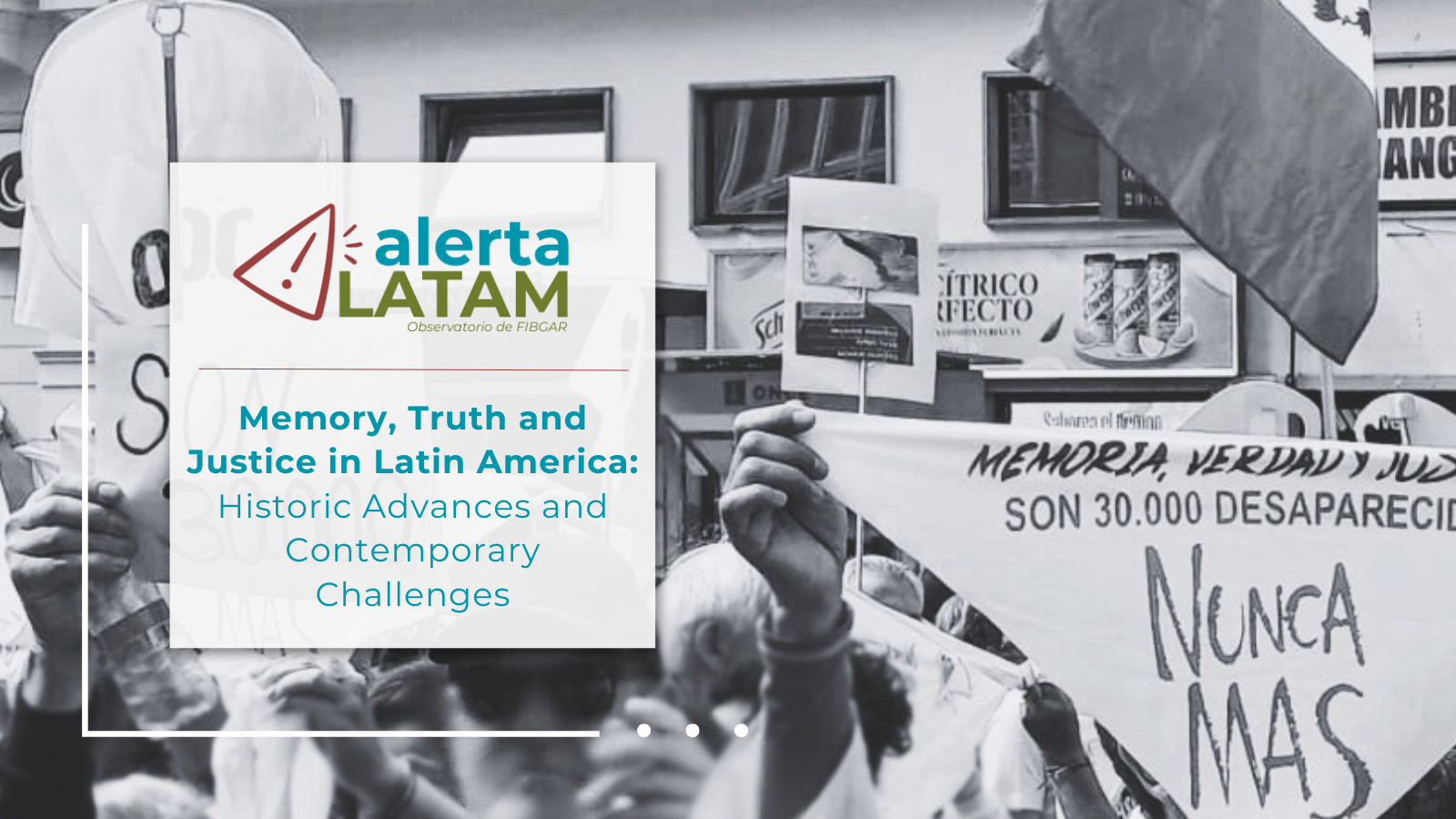
Memory, Truth and Justice in Latin America: Historic Advances and Contemporary Challenges
Every 24 March, in the framework of the National Day of Remembrance for Truth and Justice, Argentina pauses its daily rhythm to look back at one of the darkest chapters in its recent history. The date commemorates the coup d’état of 1976, which marked the beginning of the country’s last civic-military dictatorship, responsible for a systematic model of repression and State terrorism. However, this exercise of memory transcends national borders and forms part of a shared history in Latin America.
From the 1950s onwards, Latin America went through a prolonged cycle of authoritarian regimes, mostly military dictatorships with civilian complicity, which extended — with varying intensities and chronologies — until the 1980s and even the early 1990s. This period was deeply marked by the logic of the Cold War, the national security doctrine promoted by the United States in the region, and the systematic persecution of alleged political opponents.
Countries such as Argentina, Brazil, Chile, Paraguay and Uruguay experienced dictatorships which, with different nuances, articulated mechanisms of coordinated and cross-border repression — such as Operation Condor — aimed at the persecution, elimination and silencing of persons considered political opponents. These regimes were largely legitimised under the argument of an alleged defence against guerrilla groups or insurgent threats in the global context. In other cases, they were directly coups d’état aimed at interrupting democratic processes and preventing or reversing the rise to power of governments arising from the popular will.
Whatever the case, this alleged legitimisation invoked was deliberately expanded by the dictatorial regimes until it became functional to their interests. State terrorism affected not only political militants considered opponents or members of armed movements, but also students, workers, trade union organisations, intellectuals, artists and even persons with no political involvement whatsoever, who were dismissed from their jobs, classified, detained, tortured, murdered or disappeared. Under the logic of the so-called “internal enemy”, suspicion — often based on personal ties, supposed ideological affinities or mere unfounded accusations — was enough to justify repression.
State violence thus operated not only as a mechanism for the elimination — in the literal sense — of political adversaries, but also as a tool of social disciplining through the imposition of terror.
These practices formed part of a common ideological matrix, strongly influenced by the national security doctrine in the context of the Cold War, which identified concrete forms of thought — real or perceived — as an existential threat. At the same time, many of these regimes promoted profound economic transformations aligned with the geopolitical and economic interests promoted by the United States in the region. The result was a devastating number of victims, as well as deep social and institutional fractures whose consequences continue, to this day, in processes of memory, truth and reparation.
Among others, in 1954 the democratically elected government of Jacobo Árbenz in Guatemala was overthrown, marking a precedent. That same year, in Paraguay, General Alfredo Stroessner took power through a coup d’état, beginning one of the longest dictatorships on the continent. A decade later, in 1964, President João Goulart was deposed by a military coup that initiated a prolonged dictatorship in Brazil.
The cycle intensified in the 1970s. In Uruguay, in 1973, President Juan María Bordaberry led an institutional rupture by dissolving Parliament with the support of the Armed Forces, consolidating a civic-military dictatorship. That same year, in Chile, the government of Salvador Allende was overthrown on 11 September through a violent coup d’état led by Augusto Pinochet, which included the bombing of the presidential palace and ended with the death of the democratically elected president.
On 24 March 1976, in Argentina, the government of María Estela Martínez de Perón was overthrown by a coup d’état that gave rise to the self-styled “National Reorganisation Process”, deepening in the region a pattern of institutional rupture and systematic repression.
Latin America is a region that has borne open wounds permanently. And, in particular, during this period repression acquired a special cruelty, leaving a toll of victims that, to this day, we still do not know in its entirety.
Half a century after those events, the path towards truth and justice has been winding, complex and unequal.
In Argentina, the Trial of the Juntas in 1985 marked a historic milestone by prosecuting the main leaders responsible for the dictatorship. The convictions generated an immediate response: threats and attacks from the civic-military power, which produced tension and political instability that once again endangered the restored democracy. In that context, the Full Stop Law and the Due Obedience Law were enacted, limiting and then closing the possibility of prosecuting those responsible for crimes against humanity.
With the arrival of Carlos Saúl Menem to the presidency in 1989, the policy of “forgetting and forgiveness” deepened, and the decision was made to pardon military leaders who had been criminally prosecuted, insofar as they had not benefited from the Full Stop and Due Obedience Laws, the military officers who had risen up during the Alfonsín government in the carapintada uprisings; the former members of the military Junta convicted for their political responsibilities and military crimes in the Malvinas War; and the leaders of armed organisations, who had been prosecuted and convicted during the presidency of Alfonsín.
However, the social response was immediate: massive demonstrations spread throughout the country, and hundreds of thousands of people marched from Plaza de Mayo in repudiation of what had been decreed. In this context, new human rights organisations emerged with the declared aim of achieving justice, such as “HIJOS”, joining the historic Grandmothers and Mothers of Plaza de Mayo.
The Menem government did not achieve the reconciliation it sought. During the 1990s, some proceedings were initiated for the crime of child abduction, which, as mentioned, had remained outside the scope of the impunity laws. These had a central value in the search for truth. To cite a paradigmatic example, in 1998 Jorge Rafael Videla was detained for the abduction and concealment of minors born in the clandestine detention centres of “Campo de Mayo”, “El pozo de Banfield”, and “Automotores Orletti”.
In that same year, 1998, there was a substantial change in State policy. Law 24.952 was enacted, repealing the Full Stop and Due Obedience Laws. The difficulty, however, lay in the fact that this law suppressed the effects of the impunity laws for the future, but its effect was not retroactive. Argentina went through a crisis of historic magnitude in 2001, which generated significant transformations in the political-bureaucratic structure.
After two years of great governmental instability, with the arrival of Néstor Kirchner to the presidency, the trials for crimes against humanity returned to the centre of the scene. Thus, in September 2003, Law 25.779 was enacted, declaring the Full Stop and Due Obedience Laws irredeemably null and void, suppressing — erga omnes and retroactively — all legal effect of these impunity laws, removing any obstacle preventing judges from investigating and punishing the perpetrators of crimes against humanity. As from this law, throughout the country, many judges declared the unconstitutionality of Menem’s pardons and investigations were reopened.
In Uruguay, the turning point came in 2005, with the election of Tabaré Vázquez (Broad Front) as president and the new executive’s willingness to pursue investigations into certain crimes, in accordance with Article 3 of the Law on the Expiry of the State’s Right to Prosecute. This process reached its final turning point in 2009, when the Supreme Court of Justice declared the Expiry of State Punitive Claims Act unconstitutional. From that point onwards—and reinforced following the ruling of the Inter-American Court of Human Rights in the case Gelman v. Uruguay (2011)—the opening of cases and sustained progress in investigations and convictions for crimes committed during the dictatorship were consolidated. Among others, the dictator Juan María Bordaberry was convicted of crimes against humanity and died under house arrest in 2011.
The dictator Augusto Pinochet was arrested in the United Kingdom in 1998 by order of Judge Baltasar Garzón, in application of the principle of universal jurisdiction. However, he returned to Chile and died in 2006 without a final conviction, although charged in multiple cases for human rights violations. The Paraguayan dictator Alfredo Stroessner was never prosecuted and went into exile in Brazil, where he died in 2006 in total impunity, without facing judicial proceedings.
In this context, transitional justice and historical memory processes in Latin America have followed diverse trajectories, marked by advances, setbacks and persistent structural obstacles. While in Argentina the prosecution of those responsible for crimes against humanity has been consolidated over time, with numerous convictions and reopened cases, other countries have advanced in a more limited or delayed manner, as in Uruguay, or have maintained broad margins of impunity, as occurred for decades in Chile and Paraguay.
Despite the progress made — including convictions of former high-ranking officials and judicial recognition of the gravity of the crimes committed — impunity continues to be a significant feature in the region, whether due to the absence of prosecution, institutional limitations or the passage of time. In this scenario, the consolidation of the principles of memory, truth and justice remains an indispensable condition not only for the reparation of victims, but also for the strengthening of the rule of law and the non-repetition of grave human rights violations.
This reality is especially critical in relation to enforced disappearance, whose nature implies that its effects persist so long as the fate or whereabouts of the victims has not been established. Thousands of persons remain disappeared in the region, keeping open not only the State obligations of investigation and punishment, but also the permanent claim of the victims and their relatives.
This framework makes it possible to situate, with greater clarity, the analysis of the case of Argentina as a relevant experience in the judicial approach to crimes against humanity, within a regional context in which different countries have attempted diverse responses to the legacies of their dictatorships.
Negationism on the Rise and Discourses Vindicating Dictatorial Governments: Current Challenges for Memory in Latin America
Despite this encouraging historical outlook, we are currently going through a democratic recession that is a worldwide tendency, and to the current questioning of democracies are added challenges to other consensuses reached in the second half of the twentieth century. Latin America is no exception to this trend and, in recent years, we have seen a systematic decline in support among the population for democratic regimes and values in the region, as well as a constant increase in indifference towards other more authoritarian models, and even overt support for them.
The Argentine case, with the rise of Javier Milei’s government in 2023, is one of the most current examples of these currents. In this regard, 50 years after the beginning of the last civic-military dictatorship, we can see how negationism — and even vindication — has been gaining momentum from official sectors. For some years now, and in an increasingly robust manner, not only have the most horrific crimes committed by the genocidal perpetrators been denied, but victims have also been discursively turned into perpetrators. Even since the presidential campaign, the authorities of the ruling party have engaged in troubling discourse, denying the number of victims of the dictatorship and even reintroducing the “theory of the two demons” as a way of justifying the crimes of enforced disappearance of the period and with a view to refounding the official memory of the dictatorship and disputing the social meanings of rejection of State terrorism. With the new government, revisionism and the vindication of the crimes against humanity of the last military dictatorship were placed at the centre of the debate. And, in an evident State practice aimed at undermining policies of memory, truth and justice, the dismantling of the State is felt particularly in these areas, ideologically understood as a governmental decision aimed at rectifying this process.
To the Argentine case is added that of another country which has recently elected in its elections a declared defender of Pinochet’s dictatorship. Neighbouring Chile has, since 11 March 2026, for the first time since the return of democracy, a president who vindicates the dictatorial past and who did not hesitate to state that if Augusto Pinochet were alive, he would vote for him.
Less than a month into his term, the new Chilean president has begun State practices that undermine the country’s transitional justice process. In this regard, the inclusion of Fernando Rabat in the cabinet as Minister of Justice was announced, who in the 2000s was part of the team of lawyers that defended Pinochet. Likewise, the recent dismissal of three heads of departments in key areas of the Human Rights Programme and the National Plan for Search, Truth and Justice for the 1,469 persons who remain disappeared since the dictatorship of Augusto Pinochet (1973–1990), is perceived by citizens as a political decision aimed at reversing that process, beyond the government’s justification in terms of efficiency. Moreover, it was announced that a decree from the previous presidency would be annulled, which sought to expropriate 117 hectares in Colonia Dignidad, a German enclave located in the south-central area of Chile, where a site of memory would be created to commemorate the victims who were held in the detention and torture centre that operated there during the dictatorship of Augusto Pinochet (1973–1990). The justification for this followed an economicist logic, following the model of its Argentine counterpart where fiscal balance is used to justify democratic deterioration. The fact that this was the most voted-for presidential candidate in the country’s history makes it evident that memory is being put at stake throughout the Latin American Southern Cone.
These narratives and public policies led by right-wing governments in the region dangerously distort the past and are aimed at the construction of power through the redefinition of the field of meanings, by disputing the significance of the recent past.
In this context, the strengthening and defence of policies of memory, truth, justice and reparation, as well as measures of non-repetition, are essential in order to continue the regional process — slow and uneven — of consolidating fairer democracies. For this reason, it is essential to call for these struggles not to be abandoned and for the processes of social reconstruction to be deepened, as they are necessary in order to ensure that these atrocious crimes are never repeated. Despite the negationism projected by some regional actors, the struggle of survivors, relatives and human rights organisations, and the search for memory, truth and justice, must continue, stronger and more relevant than ever in Latin America.
By Javier Graña, Martín Consoli, coordinators of the Alerta LATAM Observatory, and Federica Carnevale, Project Manager at FIBGAR and coordinator of the Alerta LATAM Observatory.
