


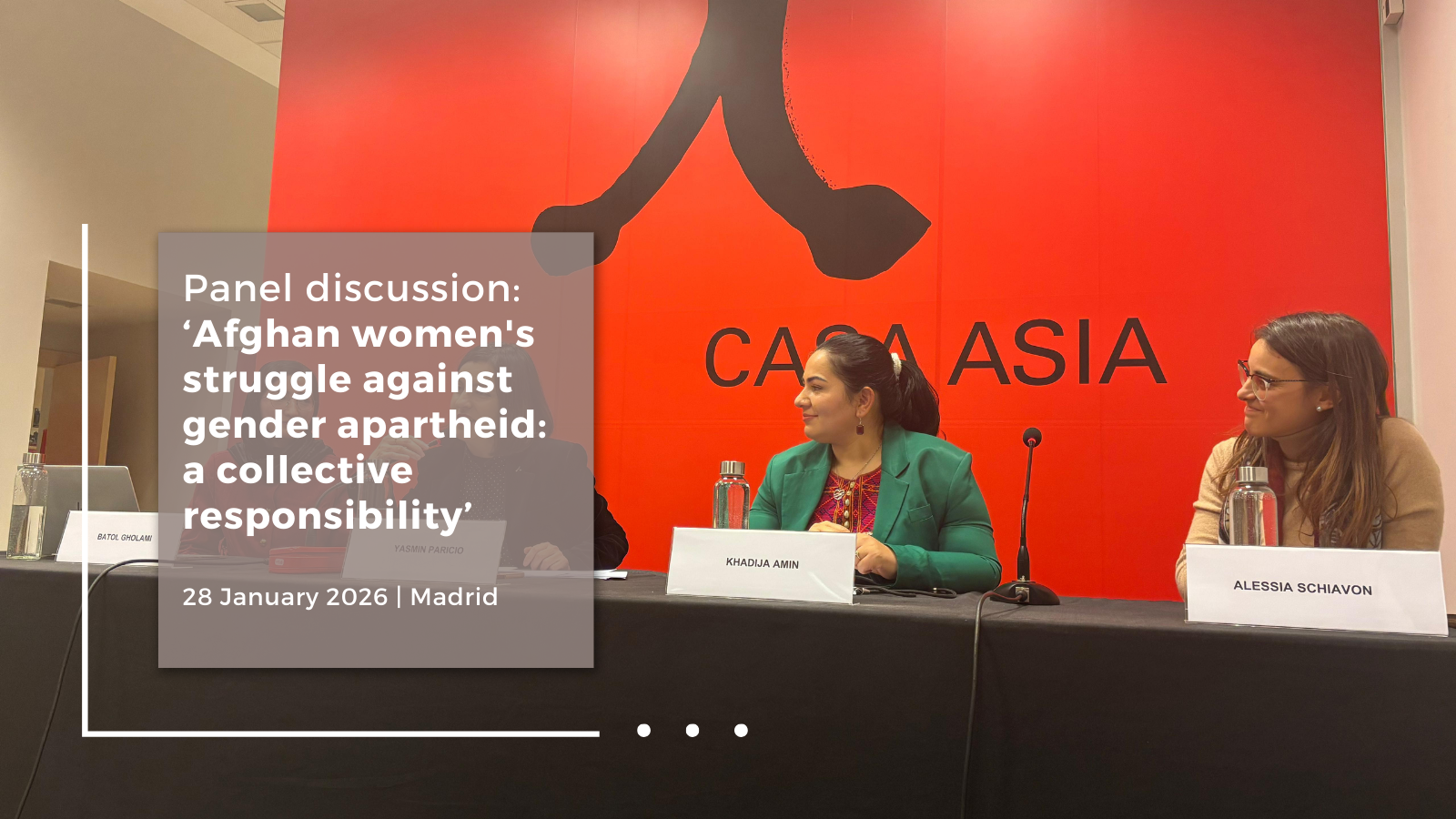
Panel discussion: ‘Afghan women’s struggle against gender apartheid: a collective responsibility’
28 January 2026 | Madrid
On 28 January, FIBGAR, as part of its RAGAA (Raise Against Gender Apartheid in Afghanistan) initiative, together with People Help, Casa Asia, Esperanza de Libertad, Netwomening, the Afghan Youth Leaders Assembly (AYLA) and the Association of Afghan Women in Spain (AMAE), held a panel discussion in Madrid entitled ‘Afghan women’s struggle against gender apartheid: a collective responsibility’. The meeting aimed to highlight the resistance of Afghan women, the initiatives arising from their fight against gender apartheid and the need for international support in this regard, on the occasion of the first meeting of the Preparatory Committee and Working Group for the UN Plenipotentiary Conference, held in New York from 19 to 30 January 2026.
The event began with welcoming remarks by José Pintor Aguilar, Director General of Casa Asia, and Ana Alonso Giganto, Ambassador for Feminist Foreign Policy at the Ministry of Foreign Affairs, European Union and Cooperation, together with the President of FIBGAR, María Garzón, and Sílvia Sala, Vice-President of People Help.
Next, Natasha Arnpriester, Senior Legal Counsel at Open Society Foundation, gave the opening speech, ‘Collective Accountability for the Future of Gender Justice in Afghanistan,’ emphasizing the importance of recognizing gender apartheid as a crime against humanity and the need for collective responsibility at the global level.
The discussion panel, moderated by Yasmin Paricio Burtin, coordinator of Policy, Society and Educational Programmes at Casa Asia, included the participation of:
- Batol Gholami, founder and CEO of AYLA and member of the board of directors of AMAE
- Khadija Amin, journalist and president of Esperanza de Libertad and member of Netwomening
- Alessia Schiavon, director of FIBGAR and coordinator of RAGAA, an initiative of FIBGAR
During the conversation, the speakers pointed out the many challenges Afghan women face under the Taliban regime —from being denied access to education and employment to being excluded from public spaces and having their basic freedoms denied— as part of a system of structural domination, and why this should be considered as gender apartheid.
They also pointed out the importance of raising visibility for the cause of Afghan women and building bridges between civil society, the international community and legal bodies in order to generate robust responses to these violations. The participants agreed that the current moment —marked by the global debate on the need to codify and internationally recognise gender apartheid as a crime against humanity— offers a key opportunity to advance legal and international accountability mechanisms that can respond to the violence suffered by millions of girls and women in Afghanistan.
In this context, particular emphasis was placed on the process at the United Nations to develop a specific instrument on the prevention and punishment of crimes against humanity, formally initiated by UN General Assembly Resolution 79/122 and currently under negotiation. In this context, the inclusion of a gender perspective and the recognition of gender apartheid as a crime against humanity were presented as necessary and crucial advances for international justice and the protection of women’s rights.
The event concluded with a networking session, during which attendees and speakers were able to exchange ideas, share experiences and establish links for future initiatives in defence of gender equality and human rights in Afghanistan.
FIBGAR reaffirms its commitment to promoting gender justice and defending the rights of Afghan girls and women, as well as its commitment to continue working closely with civil society and the international community to amplify the voices and demands of girls and women who continue to resist daily structural violence.
