

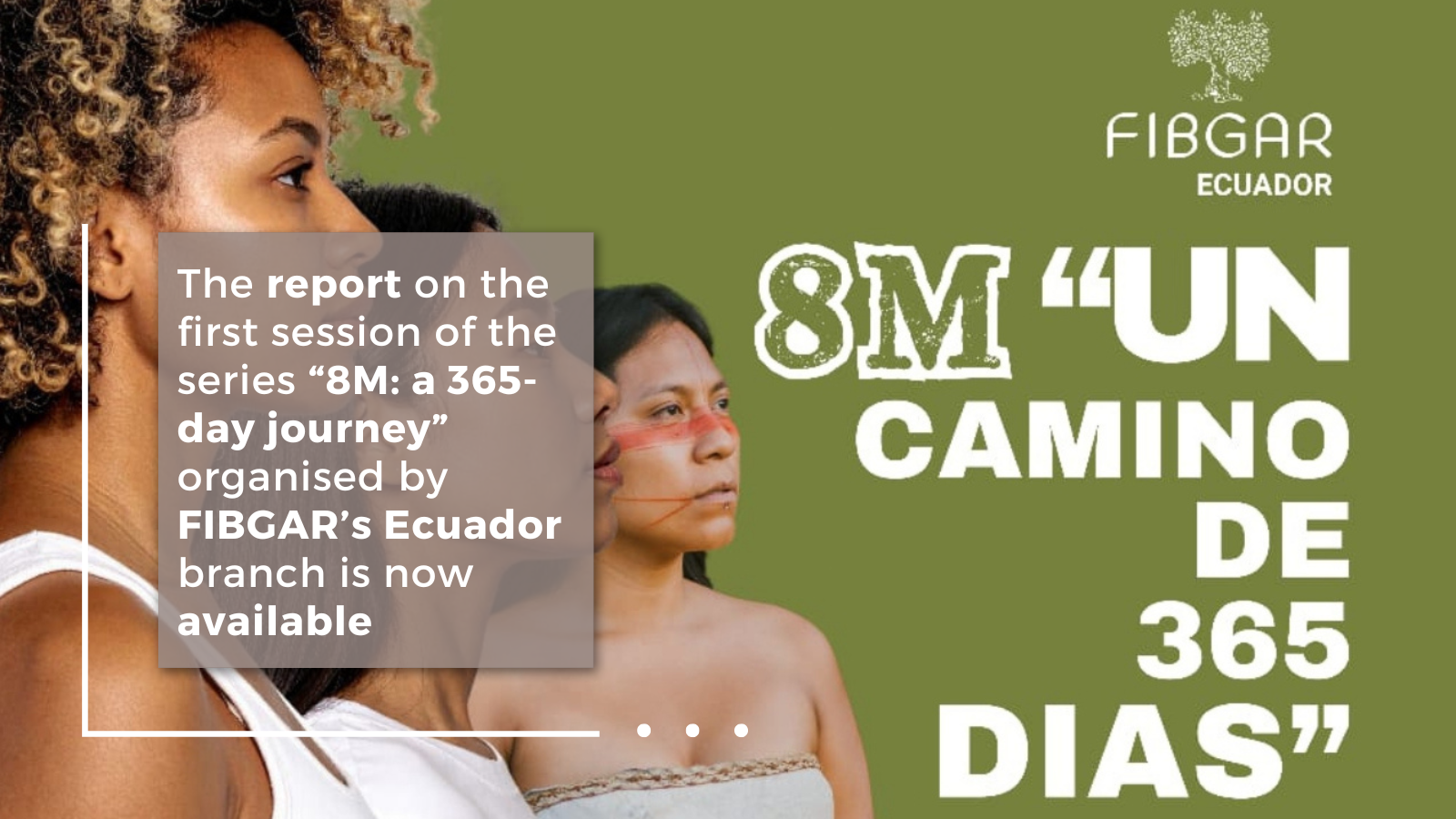
The report on the first session of the series “8M: a 365-day journey” organised by FIBGAR’s Ecuador branch is now available
FIBGAR’s Ecuador office presents the report on the first session of the series “8M: a 365-day journey”, an initiative designed to promote ongoing spaces for reflection, dialogue and education on women’s rights and the challenges that remain in achieving substantive equality in the various spheres of social, political, economic and cultural life. This first session was dedicated to analysing political gender-based violence, an issue that continues to limit women’s full and effective participation in representative and decision-making bodies.
Entitled “Women and Politics: Political Gender-Based Violence”, the event brought together specialists from Ecuador and Peru from the judicial, academic and political spheres, who shared experiences, reflections and analyses on the legislative progress made in recent years, as well as on the challenges that still remain in ensuring political participation free from discrimination and violence.
The event featured presentations by Antonia Saquicuray, a Peruvian judge; María Dolores Miño, a lawyer and director of the Observatory on Rights and Justice in Ecuador; and Paolina Vercoutere, deputy prefect of Imbabura. Drawing on complementary perspectives, the speakers addressed issues relating to judicial independence, the implementation of legislation on gender-based political violence, the protection of women’s political rights, and the specific experiences of those who have faced this type of violence whilst carrying out public duties.
One of the main points of consensus that emerged during the meeting was the recognition of gender-based political violence as a specific manifestation of the structural inequalities that have historically limited women’s participation in public life. The participants agreed that these acts of violence are not isolated incidents, but rather stem from social, cultural and institutional dynamics that continue to perpetuate unequal power relations.
The debate also provided an opportunity to reflect on the challenges posed by the implementation of existing regulatory frameworks. In particular, the discussion analysed the tensions that may arise between protection against gender-based political violence and other fundamental principles of democracy, such as freedom of expression, the right to political criticism and the scrutiny of public administration. The speakers emphasised the need to strike the right balance between these rights in order to avoid both situations of impunity and undue restrictions on democratic debate.
Likewise, the importance of adopting intersectional approaches was highlighted, enabling an understanding of how different factors of discrimination can exacerbate the situations of vulnerability faced by many women in the political sphere. The personal, professional and emotional impact of such violence was also emphasised, as was the need to strengthen support networks, support mechanisms and more effective institutional responses.
As a result of the session, the participants identified various lines of action aimed at strengthening the prevention, investigation and punishment of gender-based political violence. These include the review of certain regulatory provisions, the strengthening of training for legal practitioners, the creation of mechanisms to monitor and follow up on judicial decisions, and the promotion of permanent spaces for training and exchange for women participating in political life.
The publication of this report marks a further step in FIBGAR Ecuador’s commitment to promoting women’s rights and strengthening more inclusive and egalitarian democracies. Through the series “8M: a 365-day journey”, the organisation will continue to foster spaces for reflection and collective action that help to highlight the barriers faced by women and promote institutional responses aimed at ensuring political participation free from violence and discrimination.
