

Universal Jurisdiction as a Tool for Gender Justice: Reflections from New York
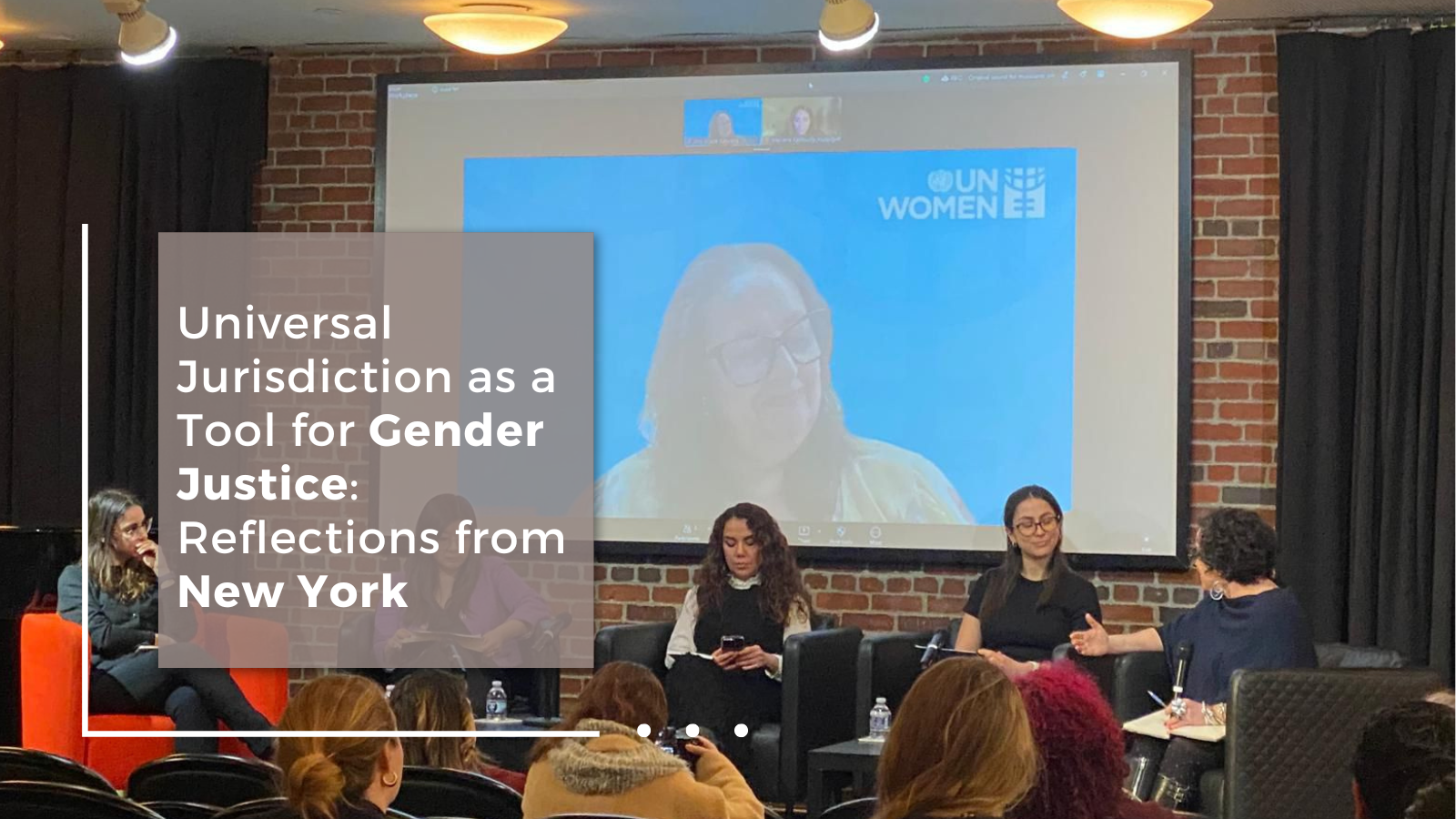
On 17 March, the event “Gender Justice and Universal Jurisdiction: Strengthening Access to Justice for Women and Girls” was held in New York, organised by FIBGAR in collaboration with the Asociación de Mujeres de Guatemala (AMG), within the framework of the Commission on the Status of Women (CSW70), the principal global intergovernmental forum dedicated to gender equality and the empowerment of women. The event took place at the Instituto Cervantes and brought together experts from the legal, institutional, and civil society spheres to reflect on the challenges and opportunities at the intersection of gender justice and universal jurisdiction.
The institutional opening was delivered by María Garzón, President of FIBGAR, who highlighted the transformative nature of universal jurisdiction as a tool against impunity, as well as the need to decisively incorporate a gender perspective into its development. She also underscored the key role of civil society and women in the construction of spaces for justice. Adilia de las Mercedes, Director of the Asociación Mujeres de Guatemala, emphasised the historical role of women in promoting universal jurisdiction, highlighting its connection with struggles against impunity and the need to recognise gender-based crimes as a central component of this instrument. She also stressed the importance of strengthening collaborative networks and creating spaces for regional and international coordination. The panel was moderated by Alessia Schiavon, Director of FIBGAR, who guided the discussion towards analysing the evolution of gender justice at the international level and the persistent challenges in incorporating a victim-centred approach.
Opening the presentations of the day, Maxine Marcus, from Partners in Justice International, offered a historical perspective on the evolution of international criminal justice, highlighting both advances and limitations in the inclusion of sexual violence crimes, as well as the need to integrate a gender perspective in a cross-cutting manner. From UN Women, Laura Quijano Ortiz shared the experience of the Special Jurisdiction for Peace in Colombia, highlighting key lessons such as the intersectional approach, the expansion of the concept of gender, and the importance of its incorporation into the institutional design of justice mechanisms.
Subsequently, Mariana Karkoutli, independent researcher and civil society representative, provided a perspective from the Syrian case, highlighting the role of universal jurisdiction in the prosecution of international crimes in the absence of effective national mechanisms, as well as the challenges faced by women survivors in accessing justice. Alicia Yamamoto, from the Atlantic Council, addressed the cases of Iran and Afghanistan, emphasising the structural dimension of gender-based violence and the need to advance in the recognition of new legal categories, such as gender apartheid, within international law.
From a regional perspective, Silvia Juárez, representing Organización de Mujeres Salvadoreñas, analysed the situation in El Salvador, pointing out the gaps between normative recognition and the reality of access to justice, as well as the relevance of universal jurisdiction in contexts of institutional weakening. To conclude the panel, Ana Grace Cabrera, from UN Women, presented the Sepur Zarco case as a reference for the incorporation of a gender perspective in justice, highlighting the centrality of victims, the principle of credibility, and the transformative impact of judicial processes.
The event concluded with a series of reflections that placed at the centre the need to rethink justice from a gender perspective, highlighting in particular that this approach implies not only addressing specific legal categories but also transforming the way in which justice processes and the relationships between those involved in them are conceived. In this regard, the importance of opening the debate to new forms of violence affecting women, such as digital violence, was underlined, as well as the need to create safe spaces that enable exchange, coordination, and the collective construction of responses.
It was also emphasised that advancing gender justice requires strengthening both the technical and human capacities of those working in these fields, placing emphasis on the need for gender-sensitive training and on the role of generational renewal in ensuring the continuity of processes. In this context, particular value was given to the shared learning among participants, as well as to the sustained commitment of women in building networks, knowledge, and strategies against impunity.
Finally, the potential of universal jurisdiction as a key tool for gender justice was highlighted, insofar as it allows for the expansion of access to justice for women, particularly in contexts where such access is limited or denied. In this regard, the need to continue strengthening this instrument was reaffirmed, incorporating new dimensions such as contemporary forms of violence and recognising existing gaps in different contexts, as well as the central role of women in claiming their rights and in building a more inclusive system of justice.
At FIBGAR, we reaffirm our commitment to the defence of the rights of women and girls, promoting a universal, accessible, and equitable justice. This event has represented an opportunity to highlight existing challenges, exchange experiences, and jointly build innovative responses that contribute to ensuring effective access to justice for all women.
