

Joint Statement: States must ensure civil society participation in negotiations on the Convention on the Prevention and Punishment of Crimes against Humanity
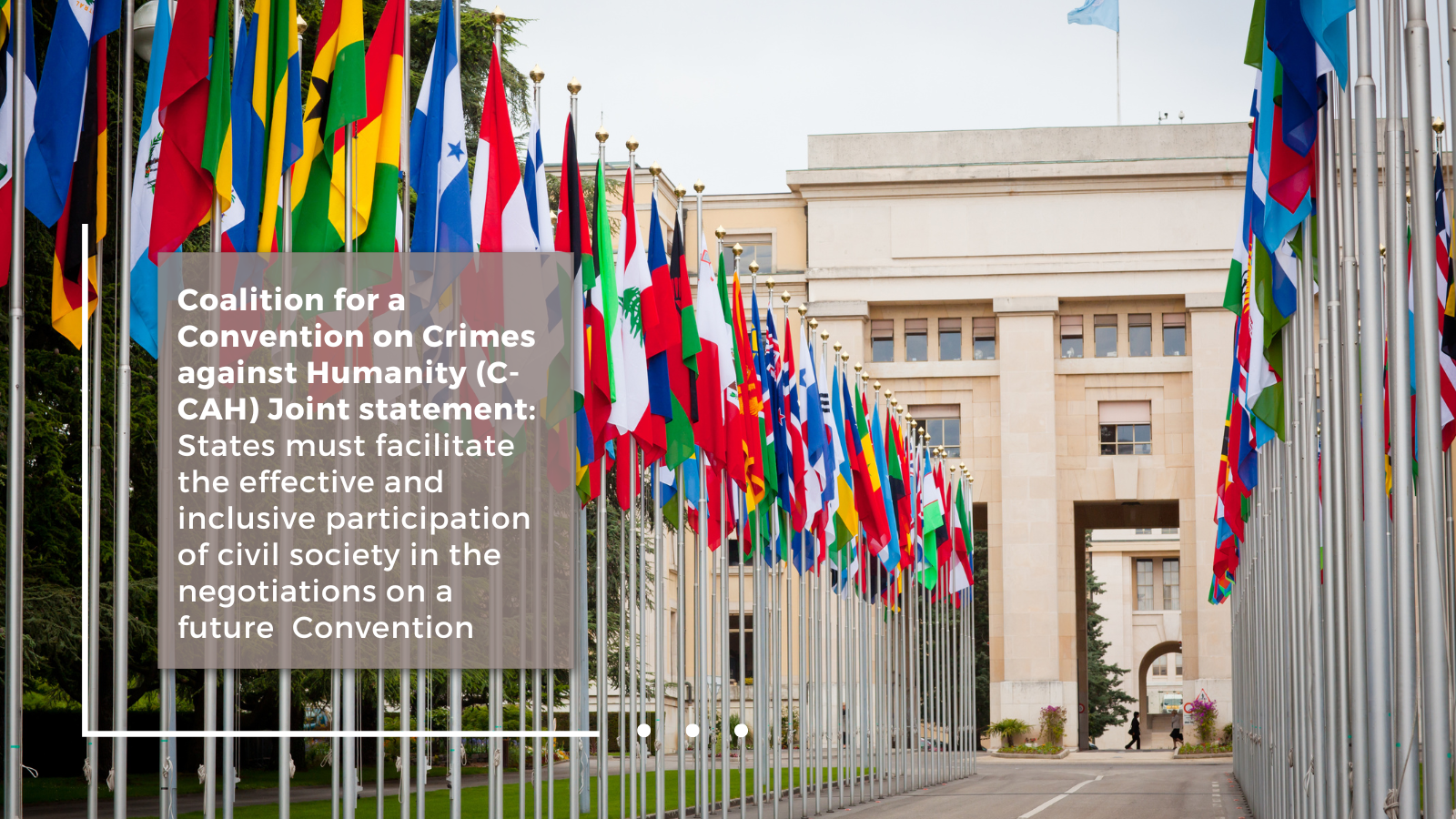
The Baltasar Garzón International Foundation (FIBGAR), as a member of the Coalition for a Crimes against Humanity Convention (C-CAH), has signed a joint statement urging States to ensure effective, inclusive and non-discriminatory civil society participation in negotiations on the future Convention on Crimes against Humanity.
Published on 12 October 2026, the statement was issued on the occasion of the general debate of the Sixth Committee (Legal) of the United Nations General Assembly on the Conference on Crimes against Humanity. In it, the signatory organisations and individuals reiterate their support for the progress made at previous sessions of the Sixth Committee and at the first meeting of the Preparatory Committee to advance the drafting of this treaty.
In a multilateral context in which progress can stall, the future Convention represents an opportunity to advance global justice and reaffirm the rule of law.
An effective, inclusive and victim-centred Convention
The Coalition for a Crimes against Humanity Convention (C-CAH) is a coalition of civil society organisations, academics and independent experts working together to promote an effective, victim/survivor-centred and non-discriminatory Convention that contributes to preventing and punishing crimes against humanity.
The statement welcomes the decision of the first Preparatory Committee to broaden participation in the future negotiating conference to committed non-governmental organisations, civil society organisations, academic institutions and private-sector entities that do not hold consultative status with the United Nations Economic and Social Council (ECOSOC). This decision takes into account the principles of transparency, equitable geographical representation and gender parity.
However, the signatory organisations stress that this progress must be translated into concrete measures. They therefore urge States and the United Nations Secretariat to ensure that diverse civil society can participate effectively both in the work of the Preparatory Committee and in the future Conference.
In particular, it was requested that interested organisations and individuals be able to submit their applications to participate sufficiently in advance, including for the second session of the Preparatory Committee and other related forums. Full participation rights are also sought, including the ability to attend and effectively address all formal meetings, as well as access to documentation and the opportunity to submit materials. It is also urged that in-person participation be possible without undue restrictions, including those relating to the number and size of delegations.
Broad consultations and participation of victims and survivors
The statement also addresses the proposals submitted by States to amend the draft articles of the Convention. The signatory organisations and individuals welcome initiatives aimed at strengthening or expanding the protection of all people from crimes against humanity and consider that these should be examined in future negotiations.
Ahead of the Conference, they urge States to make use of the preparatory period to organise consultations on substantive issues, in accordance with United Nations General Assembly Resolution 79/122. These consultations may take place at global, regional, national or thematic level and should include civil society representatives and relevant experts.
The statement also highlights the importance of consulting victims and survivors broadly to understand their priorities and expectations regarding how they wish to participate in the treaty’s drafting, adoption and implementation processes. To make this participation effective, it calls for the necessary resources and conditions to be provided, including funding, assistance, accommodation and support, outreach activities and public information initiatives.
Negotiations with a gender and intersectional perspective
One of the statement’s main demands is to ensure that both the negotiating process and the future Convention incorporate a gender and intersectional perspective.
The signatory organisations call for gender-based harms to be meaningfully recognised, for specialised expertise in this area to be incorporated, and for gender parity to be ensured among participating delegations. They also advocate an intersectional approach that takes into account the multidimensional experiences of victims and survivors.
The statement further insists that both the negotiations and the final text of the Convention must strengthen, rather than weaken, existing international legal standards, including those relating to human rights.
Furthermore, given the possibility that certain circumstances may prevent inclusive in-person participation in New York by all United Nations Member and Observer States, the signatory organisations request that consideration be given to moving the meetings to a venue outside the United States of America.
Civil society’s commitment to international justice
Through this joint statement, FIBGAR and the other signatory organisations and individuals reiterate their willingness to contribute to this process and to engage constructively in the consideration of proposals genuinely aimed at improving the current draft articles.
The future Convention on Crimes against Humanity represents an opportunity to strengthen the international legal framework for preventing and punishing these crimes. To achieve this, it is essential that its drafting take place through a transparent and inclusive process that incorporates civil society contributions and places the rights, needs and experiences of victims and survivors at its centre.
To read the full joint statement, click here.
