


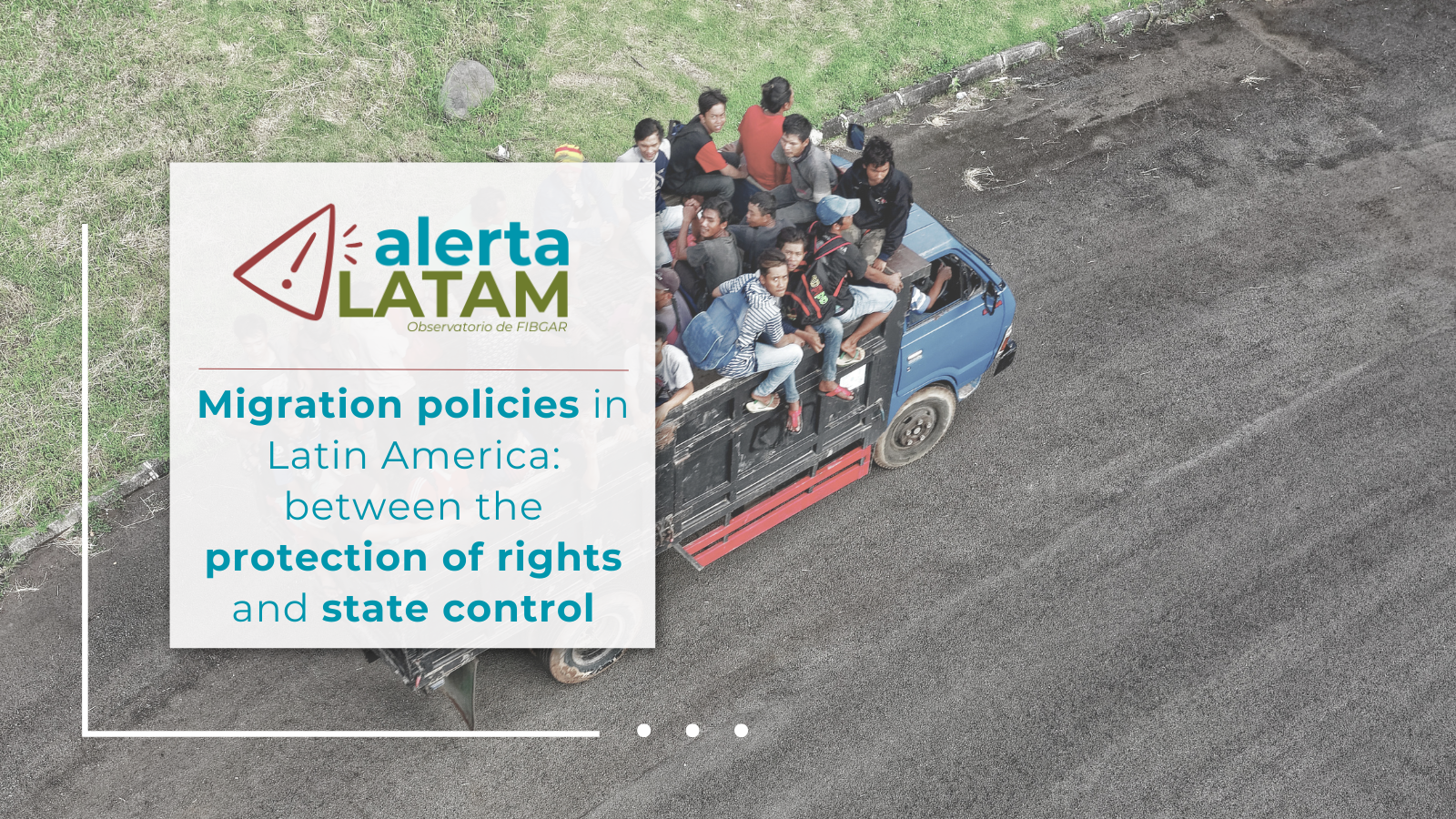
Migration policies in Latin America: between the protection of rights and state control
“The earth belongs to everyone, just like the air,” wrote the poet Jorge Debravo, alluding to the longing for a world without borders.
Today, millions of people lack access to the basic conditions needed to live with dignity in their countries of origin and turn to migration in search of new opportunities, with the aim of securing their basic rights. These needs have intensified at various points in human history; it is a cyclical phenomenon and is currently in a particularly critical phase.
Toward the 19th and 20th centuries, human mobility intensified with industrialization, world wars, and economic crises. From the waves of migration in which millions of people moved from Europe to the Americas, to the mass displacements of refugees caused by armed conflicts: each wave of migration has been different throughout history, but the essence has remained the same. Migration—according to the International Organization for Migration (IOM)—is always defined as a “movement of people from their usual place of residence to a new place of residence, whether across an international border or within a country”; therefore, it can be temporary or permanent, for any reason, regardless of the person’s legal status or length of stay.
These processes entail a transformation of the existing social fabric. And if the governments of destination countries fail to develop the necessary public policies to offer migrants a dignified process of social integration, this can be particularly complex. In this regard, experts assert that these migratory flows: “can contribute to greater development and an improvement in economic and social conditions or, conversely, help perpetuate stagnation and inequality.”
Advances in International Protection Mechanisms for Migrants.
Migration remains a global phenomenon today. Driven by structural factors such as inequality, violence, climate change, and globalization, it is steadily increasing in all regions of the world.
In this context—given the urgency of the current situation—efforts have been made to address regulatory gaps in this area and the significant fragmentation of instruments regulating the human rights of migrants through the adoption of soft law instruments, given the difficulty states face in assuming binding and far-reaching legal commitments.
Thus, within the framework of the United Nations Intergovernmental Conference—held in 2018—the Global Compact for Safe, Orderly, and Regular Migration (GCM) was adopted, establishing itself as the first legally non-binding framework for international cooperation on migration. This instrument marked a historic step in the governance of international migration, as it contained clear political commitments made by States to promote safe migration.
The pact focused on strengthening human rights. In this regard, some of its main objectives include: reducing the causes that force people to migrate, such as poverty or violence; ensuring clear information; preventing irregular migration; combating human trafficking; promoting the integration and social inclusion of migrants; and fostering international cooperation.
The impact of the COVID-19 pandemic on human mobility.
By mid-2020, the United Nations (UN) reported that the scale of international migration in recent years amounted to a total of 281 million international migrants.
In turn, in the context of the COVID-19 pandemic, it was noted that migrants were facing significant difficulties in exercising their economic, social, and cultural rights—or were at greater risk of being unable to do so.
In this regard, discrimination in access to housing, education, health care, employment, and social security—since certain laws and policies do not adequately protect them or take their specific needs into account—meant that in many cases—even amid this exceptional health crisis—they were unable to access basic services or could only do so under conditions falling short of international human rights standards. Similarly, this vulnerability was exacerbated for irregular migrants, who found themselves exposed to greater discrimination, exploitation, and marginalization, as they did not seek legal protection mechanisms for fear of being deported to their countries of origin.
Moreover, as the world began to reopen following the restrictive measures resulting from the COVID-19 pandemic, migratory movements increased even further: due to the health and economic crisis, which led to the loss of numerous jobs, new migration needs arose.
The Migration Situation in Latin America
The Latin American region, like virtually every region in the world, is currently facing a complex migration crisis.
In this context, the countries of Central America—generally known as “transit countries”—deserve particular attention, as they are not the final destination for migrants; the primary goal of many people on the move is typically to reach the United States of America.
In this context, to facilitate mobility with neighboring states and primarily to guarantee the essential human rights of people on the move, the CA-4 Central American Free Movement Agreement was signed between El Salvador, Guatemala, Honduras, and Nicaragua. This agreement allows nationals of the signatory countries to transit without a passport, through streamlined and simplified immigration procedures.
For their part, in recent years, South American countries have progressively become final destinations for migration, rather than merely transit countries. This reality has become particularly established over the last decade, as a result of the significant increase in the migratory flow of Venezuelans toward neighboring countries. In this context, many migrants have chosen to settle temporarily or permanently in neighboring host countries, creating a need to strengthen legal frameworks, public policies, and protection mechanisms aimed at their integration and the guarantee of their rights.
By mid-2018, according to figures from the United Nations, an estimated 2.3 million Venezuelans had migrated primarily to Colombia, Ecuador, Peru, Brazil, and Chile. Likewise, as of August 1, 2018, UNHCR had registered 299,016 asylum seekers, and 585,996 people from Venezuela had opted for other regularization alternatives.
To address this situation, the Quito Declaration on Human Mobility of Venezuelan Citizens in the Region was adopted in 2018, in which representatives of the governments of Argentina, Brazil, Chile, Colombia, Costa Rica, Ecuador, Mexico, Panama, Paraguay, Peru, and Uruguay established a framework for regional cooperation to manage the migration of Venezuelans in a coordinated, supportive, and humanitarian manner. In this regard, their protection, regularization, and integration in the host countries were promoted. Subsequently, this instrument gave rise to the “Action Plan of the Quito Process on the Human Mobility of Venezuelan Nationals in the Region,” which provided for the development of mechanisms for legal residency, regularization processes, and humanitarian assistance for these citizens.
Some countries, such as Ecuador—pursuant to Decree 826 of 2019—even established humanitarian measures aimed at the immigration regularization of Venezuelan citizens. This granted amnesty to those who entered irregularly or were in an irregular immigration status due to overstaying their permitted stay and who had not violated any laws, allowing them access to a temporary exceptional residence visa, with the aim of facilitating their legal stay in the country, guaranteeing their access to basic rights, and promoting their social and economic integration under conditions of order and legal certainty.
Despite this, the internal violent conflicts Ecuador has faced in recent years created a context of growing concern for public safety, which prompted the State to adopt new regulatory measures. In this context, a new immigration regulation was enacted in 2025, aimed at strengthening controls on the entry, stay, and departure of individuals, incorporating a more restrictive, security-oriented approach.
For its part, Chile, a country with a long history of receiving immigrants from other continents as well as from its neighboring countries in the region, and which on April 11, 2021, had consolidated the Migration and Foreigners Act, incorporating an approach to orderly, safe, and regular migration that recognizes rights, is currently facing setbacks. In this regard, with the inauguration of the new government, the first measures regarding migration policy were announced: in a national address on April 17, 2026, President José Antonio Kast announced the start of a process of mass deportations of undocumented migrants, as part of a policy to tighten migration controls. The measure was justified by the alleged links of some of these migrants to organized crime networks, and, in this context, one of the first decrees was issued to implement the so-called “Border Shield Plan,” aimed at strengthening control in the northern part of the country.
Another country that, after establishing itself as one of the main receiving nations in the Southern Cone, has restricted its immigration policy, leading to the securitization of the process and the criminalization of migrants, has been Argentina. Despite having a Migration Law—No. 25,871—in line with international human rights standards, passed in 2003 and still in force, which recognizes regularization as a right of the migrant and an obligation of the State, with Milei’s rise to power, there have also been very negative impacts on migration policies. In May 2025, the government of Javier Milei approved a new Decree of Necessity and Urgency (DNU) 366/2025 that restricted the rights of migrants—rights that the Argentine National Constitution recognizes for all persons residing in Argentine territory—and expanded the grounds for expulsion; it also reformed the Law on Ministries and transferred the management of migration policies to the Ministry of Security through DNU 793/2025. Under this logic, and from a perspective of “national security” and the criminalization of migrants, ethnic and racial profiling raids have been carried out in recent months in various neighborhoods of the City of Buenos Aires.
Conclusions
It is indisputable that migration constitutes a historical and ongoing phenomenon that has been present throughout all stages of human development. It is a complex and multidimensional process, influenced by economic, social, and political factors, which gradually acquired a humanitarian dimension thanks to the international instruments developed after World War II.
In the current context, migration takes on a dual dimension, as it can represent an opportunity for development and integration, but also a challenge for states in terms of management, protection of rights, and social cohesion. This is especially evident in regions such as Latin America, where migratory movements have increased in scale and diversity, creating a need for coordinated responses and appropriate public policies.
Despite the diversity of migration policies adopted by states, there are minimum standards of rights and protection that must be guaranteed in all contexts, by virtue of the principle of the progressive realization of rights and the commitments undertaken by states at the international level. In this regard, respect for human dignity and the fundamental rights of migrants constitutes a legal limit on any restrictive policy.
Historical experience demonstrates, in addition to the cyclical nature of migration, that countries that are currently recipients of migratory flows were also, at other times, sources of emigration, especially during periods of economic prosperity. Therefore, migration must be understood as a constant and reciprocal phenomenon, requiring responses based on solidarity, international cooperation, and respect for human rights.
Mariluz Barajas Cáceres, FIBGAR contributor.
BIBLIOGRAPHY
Castles, S. (2000). International migration at the beginning of the 21st century: global trends and challenges. International Social Science Journal, 165(1), 17-32.
Rodríguez, L. C. (2023). The Global Compact for Safe, Orderly, and Regular Migration Four Years Later. Spanish Journal of Development and Cooperation, 50(1), 31-41. http://dx.doi.org/10.5209/redc.85015
Fajardo Del Castillo, T. M. (2019). The Global Compact for Safe, Orderly, and Regular Migration: A Soft Law Instrument for Migration Management that Respects Human Rights, p. 4. DOI:10.17103/reei.38.02
El Salto, The Tightening of Migration Policies in Argentina, 2026: https://www.elsaltodiario.com/argentina/endurecimiento-politicas-migratorias-argentina#
United Nations. Global Compact for Safe, Orderly, and Regular Migration (GCM). OHCHR and Migration. UN. https://www.ohchr.org/es/migration/global-compact-safe-orderly-and-regular-migration-gcm
International Organization for Migration. UN Migration. Fundamentals of Migration. IOM. https://www.iom.int/es/fundamentos-de-la-migracion
United Nations. Migrants. Protect, Don’t Marginalize. UN. un.org/es/fight-racism/vulnerable-groups/migrants
United Nations Network on Migration. (2026). Report on the implementation of the Global Compact for Safe, Orderly, and Regular Migration (GCM) in the context of preparations for the International Migration Review Forum (IMRF). (2026): https://migrationnetwork.un.org/system/files/resources_files/20260420-informe-de-la-republica-de-el-salvador-implementacion-del-pmm-pdf
National Assembly. (February 6, 2017). Organic Law on Human Mobility. Official Gazette Supplement. https://biblioteca.defensoria.gob.ec/handle/37000/1705
Organization of American States (2028). Joint Declaration for the Development of a Regional Response to the Massive Arrival of Venezuelans in Countries of the Americas by the Inter-American Commission on Human Rights and United Nations Committees, Bodies, and Special Procedures. OAS. https://www.oas.org/es/cidh/prensa/comunicados/2018/197.asp
Presidency of the Republic. (July 25, 2019). Executive Decree No. 826. Official Gazette No. 5. [Ecuador]. App.vlex.com/vid/800480245.
Ubilla, Rodrigo., Rebolledo, Daniel., & Rosende, M. J. (2022). The New Reality of Migration in Chile. Ser. Inf. Soc. Política, 184, 4–28.
Law No. 21,325. Migration and Foreigners Act. April 20, 2021 (Chile). https://www.bcn.cl/leychile/navegar?idNorma=1158549
Caracol Noticias. (April 16, 2026). Chile begins mass deportations of undocumented immigrants. Caracol Radio. https://www.noticiascaracol.com/mundo/chile-anuncia-el-inicio-de-deportaciones-masivas-no-deben-continuar-en-nuestro-pais-dijo-kast-rg10
