


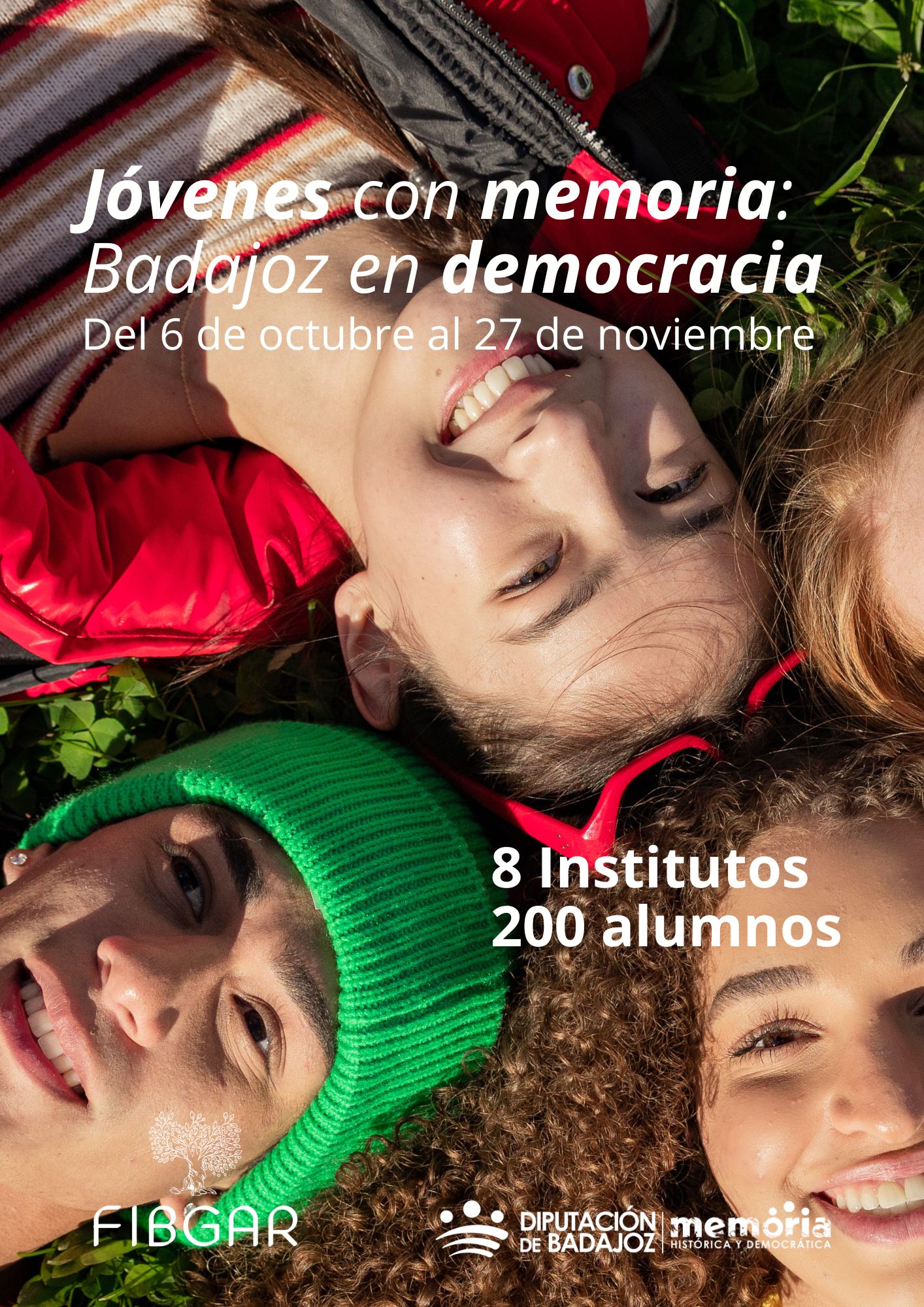
The Badajoz Provincial Council and FIBGAR are promoting the “Young People with Memory: Badajoz in Democracy” initiative to raise awareness of democratic memory and human rights amongst young people in the province
The project will visit eight secondary schools between October and November with the aim of raising awareness amongst the younger generation about the Spanish Civil War and the Franco regime, and helping them to recognise, through an understanding of the past, the risks that may threaten democratic coexistence today.
The Badajoz Provincial Council and the Baltasar Garzón International Foundation (FIBGAR) present ‘Young People with Memory: Badajoz in Democracy’, an educational initiative aimed at secondary school pupils in the province, funded by the Badajoz Provincial Council’s Historical Memory Service.
Its aim is to raise awareness amongst younger generations of the importance of democratic memory and human rights as the cornerstones of a free, just and pluralistic society.
The project is based on a firm belief: understanding the past is essential to comprehending the present and building the future. To this end, it invites students to explore the history of the Spanish Civil War and the Franco dictatorship, with a particular focus on events in their own region, and to reflect on what it means today to defend truth, justice, reparation and guarantees of non-repetition.
Understanding the past to protect the present
Democracies are not a final destination. They are a space for coexistence that is sustained day by day thanks to the commitment of its citizens. History shows that hard-won rights and freedoms can be lost, and that this process rarely happens overnight. It is usually preceded by warning signs: the dehumanisation of those who think differently, the normalisation of hate speech, the spread of false narratives, contempt for democratic institutions, or the justification of violence as a political tool.
Understanding how social cohesion broke down in Spain in the 1930s and the consequences of the Civil War and nearly four decades of dictatorship provides young people with the keys to identifying these warning signs when they appear in their own time. Democratic memory does not look back out of nostalgia or to reopen old wounds. It does so to equip current generations with the critical tools to confront disinformation, intolerance and any attempt to erode human rights.
This task is particularly necessary today. Young people are growing up in a digital environment where information and misinformation coexist, and where the past can easily be simplified, trivialised or distorted. Furthermore, the first-hand accounts of those who lived through that era are disappearing. It is therefore urgent that the younger generations take up the mantle of remembrance, learn the histories of their towns and cities, and understand that the democracy they enjoy is the result of the effort and sacrifice of many people over several generations.
A memory built in the classroom
Between October and November 2026, the project will be rolled out to eight secondary schools in the province. It will combine participatory sessions spread across two workshops with a research project that each school will carry out with its teaching staff. This approach places the pupils at the centre: they do not merely acquire knowledge, but also research, ask questions and develop their own perspective on the history of their local area.
As a result, the pupils will collectively create the Route of Democratic Memory for the Province of Badajoz. Each secondary school will contribute a place or a historical event from its local area. The route will remain as a legacy shared with all citizens and as a demonstration that memory is also built from the local level – from the streets, the buildings and the names that form part of each community’s history.
Through this initiative, the Badajoz Provincial Council and FIBGAR reaffirm their commitment to education in democratic values. Such education fosters young people who are informed, critical and aware that defending human rights is everyone’s responsibility.
For more information you can click here.
