


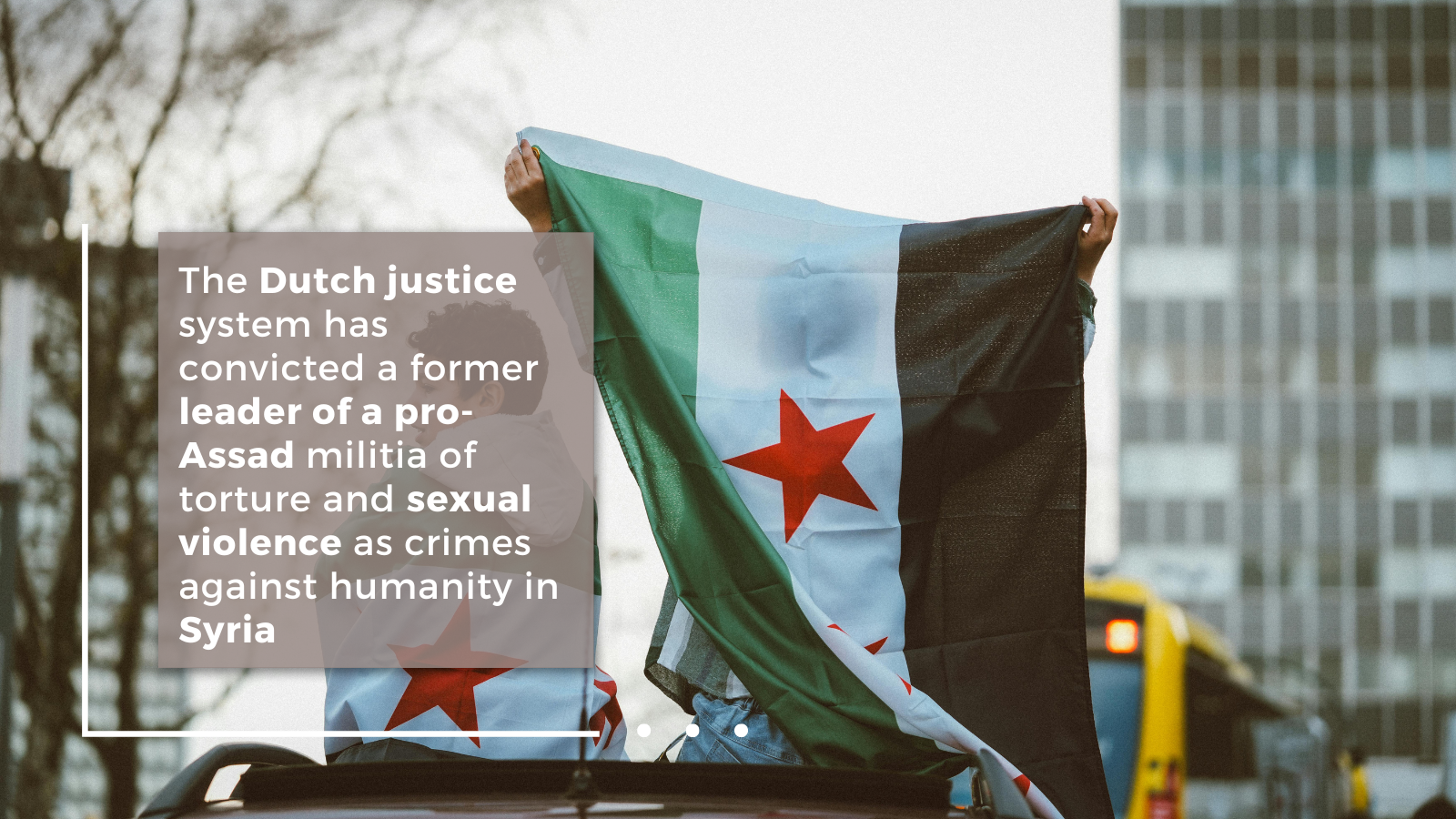
The Dutch justice system has convicted a former leader of a pro-Assad militia of torture and sexual violence as crimes against humanity in Syria
On 15 June 2026, the District Court of The Hague sentenced Rafiq al-Qatrib, a former leader of the National Defence Forces (NDF), a paramilitary militia linked to Bashar al-Assad’s regime, to 26 years’ imprisonment for crimes against humanity and war crimes committed in Syria between 2013 and 2014.
The verdict marks a milestone for the Dutch justice system. It is the first conviction handed down in the Netherlands for crimes attributed to forces acting in support of the Syrian regime and, furthermore, the first time a Dutch court has recognised certain forms of sexual violence as crimes against humanity.
A historic verdict for Syrian victims
According to the facts established in the case, between 2013 and 2014 al-Qatrib served as head of the interrogation department of the National Defence Forces in the city of Salamiyah, in the governorate of Hama. The NDF was established in 2012 as a paramilitary structure comprising various militias that fought alongside Syrian government forces during the armed conflict.
According to investigations carried out by the Dutch Police’s International Crimes Team, the defendant participated in acts of torture, rape and other forms of sexual violence committed against civilians detained in various detention centres in and around Salamiyah. During the trial, the prosecution described him as “the lord and master of the interrogation room”, emphasising the control he exercised over the locations where the abuses took place.
Al-Qatrib arrived in the Netherlands in July 2021 as an asylum seeker and settled with his family in the town of Druten. Shortly afterwards, the Dutch authorities received information about his alleged involvement in crimes committed in Syria. The investigation was finally formally launched following a complaint lodged in November 2021 and various statements from victims and witnesses that enabled the events to be reconstructed. This is because, in the case of the Netherlands, the exercise of universal jurisdiction is primarily regulated by the Wet Internationale Misdrijven (International Crimes Act) of 2003, which was adopted following the ratification of the Rome Statute. This law empowers Dutch courts to investigate and try such offences even when they have been committed outside Dutch territory and by foreign nationals; it is characterised by a limited form of universal jurisdiction, as, in practice, the presence of the suspect on Dutch territory is required to initiate criminal proceedings.
The defendant was arrested on 8 December 2023. Consequently, following several preliminary hearings held between 2023 and 2025, the trial commenced in April 2026 before the District Court of The Hague.
In its judgment, the court found al-Qatrib guilty of 19 crimes against humanity and war crimes committed against eight victims in three detention centres. The judges concluded that al-Qatrib had participated in acts of torture, rape and other forms of sexual violence, which the court regarded as part of a systematic attack against the civilian population. Furthermore, during the reading of the judgment, the court noted that the accused had dehumanised and deeply humiliated the detainees, concluding that he derived satisfaction from the acts of torture and humiliation he inflicted.
The extreme gravity of the proven offences and the compelling nature of the testimonies were decisive factors in the imposition of a 26-year prison sentence. Although the prosecution had sought a harsher sentence, the sentence imposed ranks among the most severe handed down in Europe in cases relating to the Syrian conflict.
Naming, prosecuting and redressing sexual violence: an urgent obligation for international justice
Beyond this historic conviction, the judgement is of particular significance due to its explicit recognition of sexual violence as a crime against humanity. For decades, this type of violence was rendered invisible or regarded as an inevitable consequence of conflict, despite its systematic use by state and non-state actors in numerous contexts of war and repression.
Conflict-related sexual violence constitutes one of the most serious forms of violence against the civilian population. International organisations have repeatedly highlighted that it is a strategy used to terrorise communities, punish groups considered enemies, control territories, destroy family ties and fracture the social fabric. Its consequences often extend far beyond the direct victims, affecting entire families and communities for generations; it is women and girls who continue to suffer disproportionately from this type of violence, although men, boys and people of diverse gender identities may also become victims of these practices.
The anthropologist Rita Segato has described this reality by stating that “the female body is a map of the violence perpetrated by men and the battlefield on which wars of power are fought”. Her words help us to understand that sexual violence is neither a collateral effect nor an inevitable consequence of war, but rather a practice consciously employed to exercise power, sow terror and send messages of domination to entire communities. Recognising this dimension is essential to understanding the gravity of these crimes and the importance of courts investigating and punishing them as part of the strategies of violence deployed in armed conflicts.
In light of this reality, judicial decisions such as that handed down by the District Court of The Hague represent an essential step forward in consolidating and building on the progress achieved by international criminal law through the tribunals for the former Yugoslavia and Rwanda, which led to the recognition of sexual violence as an international crime.
Furthermore, the case of Rafiq al-Qatrib is yet another example of the role that universal jurisdiction can play in the fight against impunity for international crimes. In a context such as that of Syria, where the prospects of obtaining justice at the national level remain extremely limited for many victims, proceedings brought in foreign jurisdictions have become a vital tool for advancing accountability. This conviction thus adds to the efforts undertaken in various European countries to investigate and prosecute crimes committed during the Syrian conflict, reaffirming the consensus that those responsible for the most serious violations of international law must not be allowed to find refuge in impunity.
However, universal jurisdiction, as the living instrument that it is, must be rethought and strengthened from a perspective that enables all victims of the most serious international crimes to be understood and supported, ensuring that no experience of victimisation is excluded from the processes of seeking truth, justice and reparation. In this regard, it is essential that normative and doctrinal developments incorporate a gender perspective across the board, and that national jurisdictions continue to promote investigations and universal jurisdiction proceedings with a gender-sensitive approach, recognising the specific gravity and differential impact of sexual and gender-based crimes which, for far too long, have been rendered invisible, downplayed or excluded from accountability processes.
Federica Carnevale, project manager at FIBGAR.
REFERENCES
Syrian Arab News Agency (SANA), The Hague sentences former militia leader to 26 years for crimes in Syria. Available at: https://sana.sy/es/local/2316370/
Europa Press, Syrian man sentenced to 26 years in prison for torture and abuse during the civil war. Available at: https://www.europapress.es/internacional/noticia-condenado-26-anos-carcel-sirio-torturas-abusos-guerra-civil-20260615184952.html
Segato, Rita Laura. The War Against Women. Madrid: Traficantes de Sueños, 2016.
United Nations, Conflict-related sexual violence. Available at: https://peacekeeping.un.org/es/conflict-related-sexual-violence
TRIAL International, Universal Jurisdiction Annual Review 2026. Available at: https://trialinternational.org/wp-content/uploads/2026/04/UJAR_2026_digital.pdf
