

We held the event “Child Enforced Disappearances: A Dialogue for Justice and Legislative Change. Voices of the Victims”
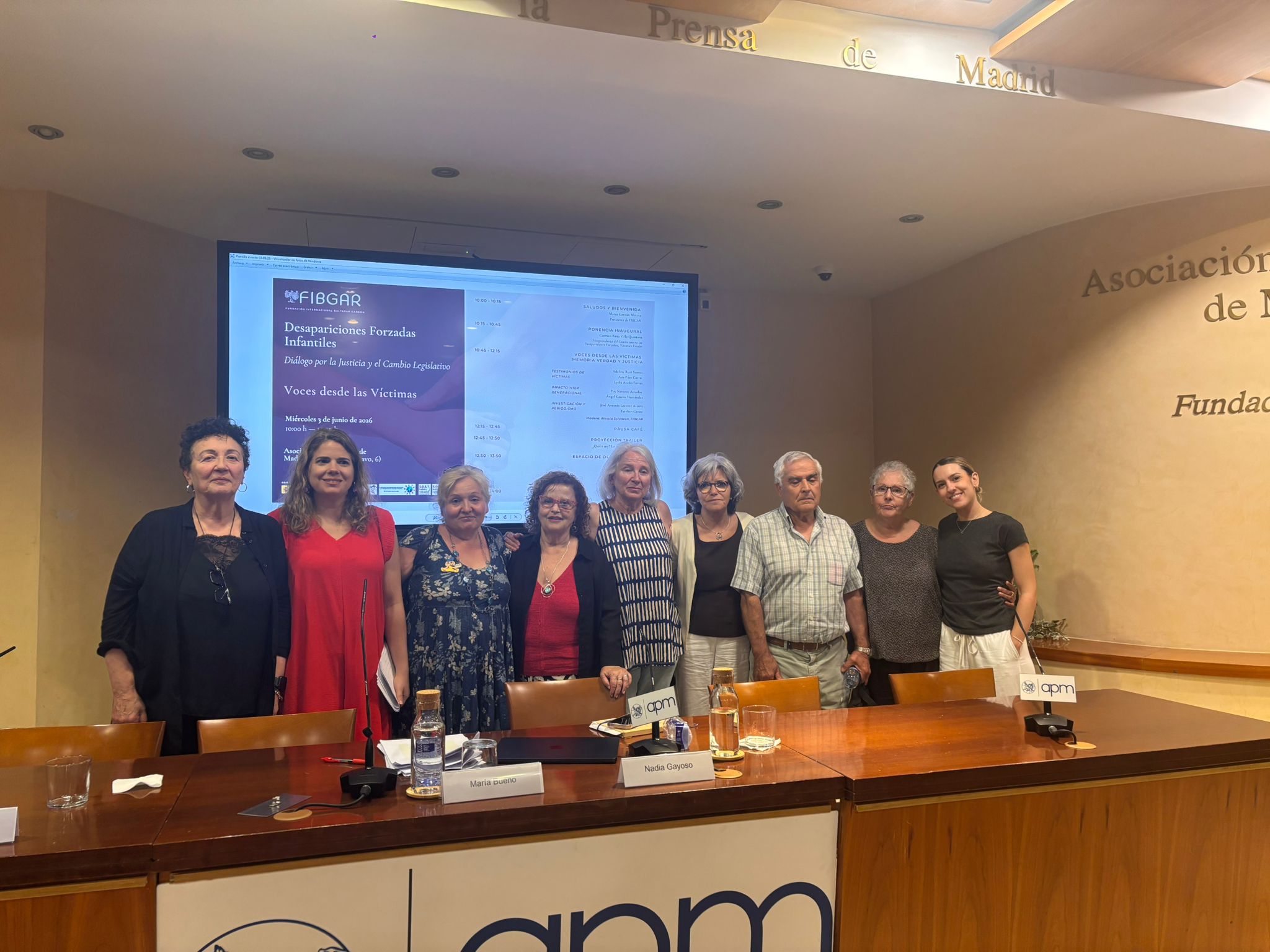
On 3 June 2026, we held the event “Child Enforced Disappearances: Dialogue for Justice and Legislative Change. Voices of the Victims”, together with the Te Estamos Buscando Platform, the ABRA Association, SOS Bebés Robados Cataluña, ALUMBRA and Adelante Bebés Robados, at the Madrid Press Association.
This event, part of the advocacy project developed by FIBGAR and co-funded by the Ministry of Territorial Policy and Democratic Memory, sought to place the primary victims of this crime at the centre: the mothers.
In this regard, the event was opened by María Garzón, president of FIBGAR, who was accompanied by Carmen Rosa Villa, vice-president of the United Nations Committee on Enforced Disappearances. Speaking remotely, Carmen reviewed the CED’s concluding observations on the enforced disappearance of children, explained cases from other countries such as Argentina, Chile and El Salvador, explored the rights of children taken from their mothers, and referred to the joint statement issued in November 2025 by various United Nations professionals regarding the enforced disappearance of children in Spain.
This was followed by the round table “Voices of the victims: memory, truth and justice”, comprising three distinct yet interconnected parts.
The first part, “Victims’ testimonies”, featured three mothers who had had their children taken from them at birth: Adelina Ruiz, president of SOS Stolen Babies Catalonia; Ana Páez, vice-president of the same organisation; and Lydia Acebo, president of the Association of People Affected by Stolen Babies in Andalusia. They explained to the audience the current situation facing the families and the obstacles they continue to encounter on their path to justice, truth and reparation.
Afterwards, Ángel Casero and Puy Navarro, siblings of babies who were victims of enforced disappearance, took the floor in the second part, “The intergenerational impact”. Their testimonies recounted how they had taken over from their mothers in the search for their missing siblings and described the impact on families, generations after facing the enforced disappearance of a child.
Finally, Esteban Creste, researcher and co-producer of the documentary ¿Quién soy? Un asunto de Estado, and José Antonio Lorente, forensic scientist and director of the Genetic Identification Laboratory at the University of Granada, concluded the panel with the section “Investigation and Journalism”. Esteban presented various cases of victims of forced child disappearances that he has encountered throughout his years of research and emphasised the importance of debunking the myths surrounding this crime with data and testimonies. For his part, José Antonio explained how the Genetic Identification Laboratory at the University of Granada works to help families identify their loved ones.
Following a coffee break and the screening of the trailer for the documentary Who Am I? A Matter of State, María Bueno, a mother who is a victim of forced child disappearances and president of the TEB Platform and the Alumbra Association, and Nadia Gayoso, head of the democratic memory department at FIBGAR, moderated an open discussion.
During the session, María shared the research carried out by Alumbra, which will soon be made public, and emphasised how essential it is for victims’ associations, institutions and other organisations to join forces to drive forward actions that advance the search for justice, truth and reparation. Nadia opened the floor to the rest of the audience, who participated in the event by sharing comments, concerns and testimonies.
Events such as this meeting are essential to continue raising awareness of the situation faced by victims of child enforced disappearances: denial of access to justice, obstacles to uncovering the truth and a complete lack of reparation.
