


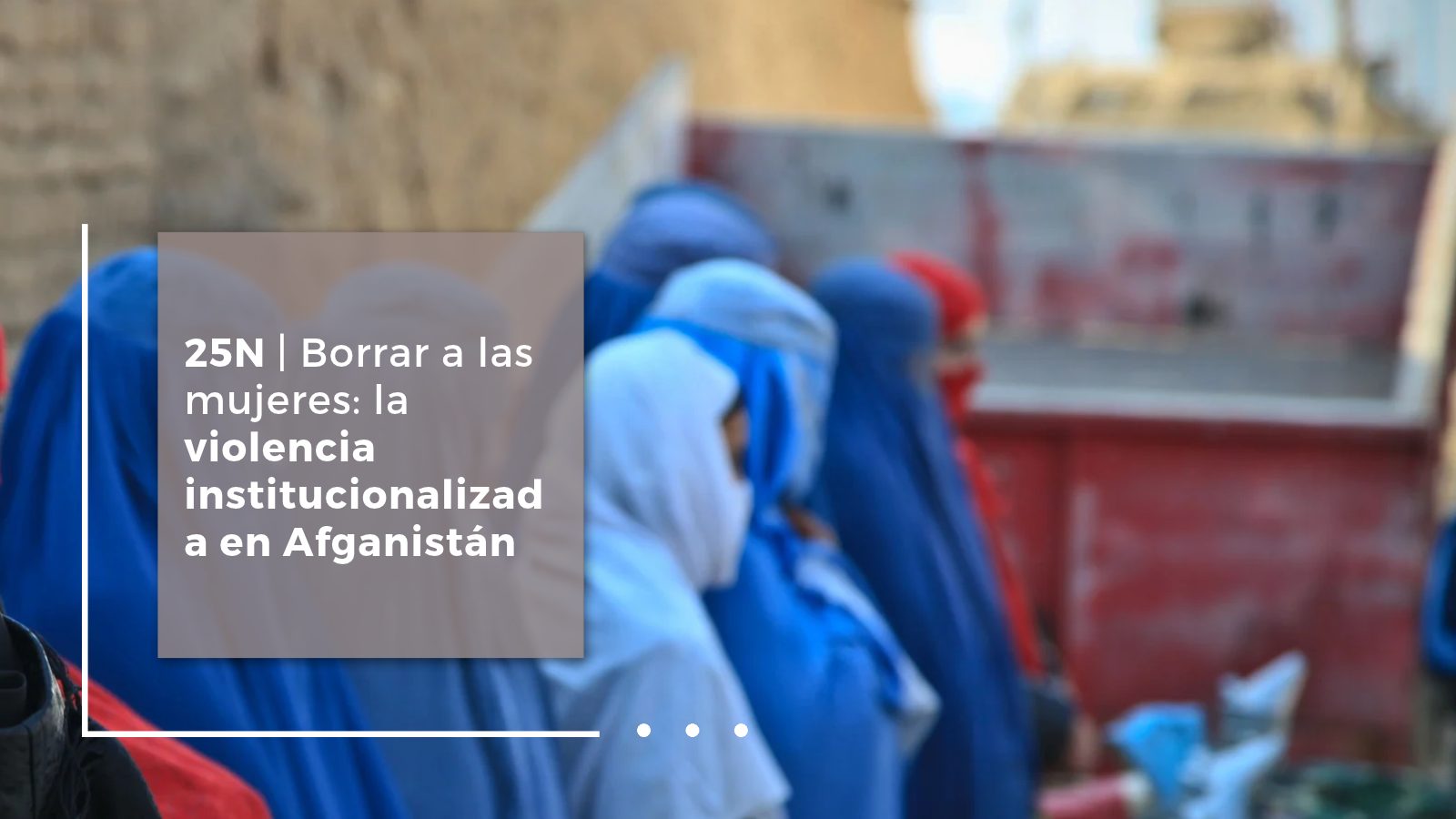
25N – Erasing women: institutionalised violence in Afghanistan
On 25 November 1960, the Mirabal sisters – Patria, Minerva and María Teresa – were murdered in the Dominican Republic on the orders of dictator Rafael Leónidas Trujillo, whose regime they opposed. In 1981, during the first Latin American and Caribbean Feminist Encuentro, held in Bogotá, activists from across the region agreed to designate this date as a day to denounce violence against women. Almost two decades later, on 17 December 1999, the United Nations General Assembly established 25 November as the International Day for the Elimination of Violence against Women through Resolution 54/134, recognising that such violence is a manifestation of historically unequal power relations between men and women. This recognition was grounded in the 1993 Declaration on the Elimination of Violence against Women (A/RES/48/104), which had already defined it as any act of gender-based violence that causes or is likely to cause physical, sexual or psychological harm.
The origin of this date is no coincidence, and its significance goes beyond the remembrance of a crime. The Mirabal sisters were persecuted and murdered for challenging an authoritarian regime, in a context in which violence against women also operated as a tool of political repression. More than six decades later, this same relationship finds one of its most extreme expressions in Afghanistan. Since the Taliban returned to power in August 2021, the restrictions imposed on women and girls have gone far beyond limiting their individual rights: they have created a system of exclusion and subordination that progressively expels them from public life, restricts their autonomy and increasingly controls every aspect of their existence. In this context, violence is not limited to acts of physical or psychological aggression; it is also exercised through rules, institutions and policies that turn discrimination into a systematic practice and impunity into a condition that perpetuates that violence.
Five years of a system that erases women
Since their return to power, the Taliban have issued more than 160 decrees, directives and orders specifically targeting women and girls, transforming discrimination into State policy. UN Women has described the situation as the world’s most serious women’s rights crisis and warns that it is at risk of becoming normalised. According to the findings of the Special Rapporteur on the situation of human rights in Afghanistan, Richard Bennett, and the Committee on the Elimination of Discrimination against Women (CEDAW), the lives of women and girls have been systematically set back in virtually every sphere.
The restrictions imposed are neither isolated nor temporary decisions. They are part of a deliberate strategy to exclude women from the public sphere and deny them their status as full rights-bearing citizens. That is why discussing violence against Afghan women requires looking beyond individual acts: what United Nations bodies describe is an interconnected system in which each form of violence reinforces the others.
Violence in many forms
Physical and sexual violence. According to data collected by UN Women in its 2024 Afghanistan Gender Index, 34.7% of Afghan women experienced physical or sexual violence by an intimate partner in the previous year, a rate three times higher than the global average. This is compounded by forced and child marriages, so-called “honour killings”, the practice of baad – whereby girls are handed over as compensation to settle tribal disputes – and sexual violence against women deprived of their liberty, in a context of silence, stigmatisation and victim-blaming. In 2023, almost 30% of girls under the age of 18 were married, and one in ten of them was under 15.
Institutional and legal violence. The protection that the law should provide has been hollowed out, and inequality has been codified: men and women are subject to different legal regimes. Following the Supreme Leader’s order in November 2022 to fully implement sharia through a binding decree, restrictions were consolidated into a structural regulatory regime. Decree No. 12 of 2026 removes legal equality between women and men, grants husbands legal authority over their wives and criminalises domestic violence only when it causes serious and visible physical injuries; Decree No. 18 of 2026 makes it harder for women to end a marriage and implicitly permits child marriage. In this regard, the new 2026 Penal Code enshrines an approach under which only violence causing serious, visible injuries is punishable, with a maximum sentence of fifteen days’ imprisonment, and recognises the right of any Muslim man –particularly husbands and “masters”– to impose corrective punishment for what he considers a “sin”. Beatings, insults and shoving cease to be offences when the victim is a woman.
This asymmetry also extends to judicial proceedings and the justice system itself. A man’s testimony is valid evidence on its own; for certain matters, a woman’s testimony requires corroboration by a man, meaning that a victim may be unable to prove the violence she has suffered because she is the only witness. A woman may be sentenced to up to three months in prison for visiting her own family without her husband’s permission. A girl’s silence after reaching puberty may be interpreted as consent to a marriage arranged during her childhood, and while men can divorce unilaterally, women can only seek an annulment before a judge. Likewise, women judges, prosecutors and parliamentarians were removed from their positions without any effective avenue of appeal, and women are almost four times less likely than men to access official justice mechanisms. This is compounded by the 2024 Law on the Promotion of Virtue and Prevention of Vice, which grants powers of detention and surveillance to thousands of agents: the so-called “morality police”.
Psychological violence. Seven out of ten women describe their mental health as “poor” or “very poor”, and almost two-thirds say their lives are worse than they expected before the Taliban returned to power. Mental ill-health is not a collateral effect, but structural harm caused by a system that turns everyday life into a space of institutionalised violence. This pressure is compounded by the repression of those who resist: the United Nations High Commissioner for Human Rights has reported arbitrary arrests, enforced disappearances and threats against women who protest; some have been detained without a warrant, held incommunicado for weeks or forced to “confess”.
Symbolic violence. In Afghanistan, women have been erased from public life: they have been subjected to a dress code requiring them to cover themselves from head to toe in a burqa or niqab, concealing even their faces; their voices have been removed from radio and television; they have been prohibited from taking part in cultural, artistic and sporting activities, and even from reciting poetry in public; they are also forbidden to speak or raise their voices in the presence of men who are not members of their family. According to data collected by UN Women, no women currently hold government office, whereas in 2020 women occupied more than 25% of parliamentary seats. This is violence that operates on the very place women are allowed to occupy in the social imagination and in shared public space: erasing them from public sight and silencing their voices is a way of telling them that they do not exist as citizens.
Economic violence. Only 7% of Afghan women are employed, compared with 84% of men, according to the PNUD. Women have been prohibited from working for non-governmental organisations and UN agencies, and sectors that provided livelihoods for tens of thousands of families have been shut down. Fewer than 7% of women have a bank account or access to mobile financial services. This forced dependence is not neutral: it increases women’s vulnerability to violence and perpetuates structural inequalities.
Educational violence. Afghanistan is the only country in the world where secondary and higher education are closed to girls and women: since September 2021, they have been unable to pursue formal education beyond the sixth grade, and since December 2022 they have been excluded from universities. UNICEF estimates that more than 2.6 million girls have been deprived of secondary education. In addition, 78% of young Afghan women are not in education, employment or training.
Violence against health and life. The ban on studying medicine, including midwifery, and rules restricting treatment by male doctors prevent many women from receiving medical care. In 2024, Afghanistan recorded a maternal mortality rate of 638 deaths per 100,000 live births, one of the highest in the world. Furthermore, according to UN estimates, the ban on education is expected to increase child marriages by 25%, adolescent pregnancies by 45% and maternal mortality by at least 50% by 2026.
From Multiple Forms of Violence to the System that Connects Them
None of these forms of violence can be understood in isolation. Education, work, health, access to justice, mobility and public representation have all been restricted simultaneously through decrees and administrative orders, with the aim of excluding women from public life and ensuring their subordination in the private sphere. It is this architecture of institutionalised domination that has led a growing number of organisations and experts to speak of gender apartheid.
International law has begun to respond to the severity of this systematic and institutionalised violence, oppression and subordination. On 8 July 2025, Pre-Trial Chamber II of the International Criminal Court issued arrest warrants for Haibatullah Akhundzada, the Taliban Supreme Leader, and Abdul Hakim Haqqani, the regime’s Chief Justice, for their alleged responsibility for the crime against humanity of persecution on gender and political grounds, pursuant to Article 7(1)(h) of the Rome Statute. In October 2025, the UN Human Rights Council also established an independent mechanism to collect, preserve and analyse evidence of international crimes committed in Afghanistan (Human Rights Council Resolution 60/2).
These are essential steps, but the current legal framework does not fully capture the intent, systematic nature and institutionalisation that characterise this regime: persecution on gender grounds describes the acts, whereas apartheid describes the system of domination that makes them possible. Gender apartheid is not currently established as an autonomous crime under international law. This makes it particularly important to include it in the future Convention on the Prevention and Punishment of Crimes Against Humanity, currently under negotiation within the United Nations. Properly naming this reality is not a semantic exercise: it makes it possible to trigger obligations to prevent such crimes and to open avenues for investigation, punishment and reparation.
What we must demand this 25 November
Faced with this reality, condemning these acts is not enough. The international community must take concrete steps to prevent this system of oppression and violence against Afghan women from going unpunished. This requires progress towards recognising gender apartheid as a crime under international law, strengthening documentation and evidence-gathering mechanisms, and promoting accountability for those who design, implement and sustain this system of oppression.
However, these demands arise in an increasingly complex international context. The weakening of multilateral commitments, cuts in funding for the defence of women’s rights in some countries and growing challenges to the principle of equality threaten to erode decades of progress. Afghanistan shows how far a State can go when discrimination becomes a systematic government policy.
On this 25 November, remembering Patria, Minerva and María Teresa Mirabal also means recognising that violence against women cannot be separated from the power structures that produce and perpetuate it. More than six decades after the events that gave rise to this day, Afghan women continue to face a system that seeks to control their bodies, limit their choices, expel them from every space of participation and subject their everyday lives to violence.
Afghanistan is, in this sense, a test for the international community. Legally recognising this reality and demanding accountability is not merely a response to the crimes committed against Afghan women: it also means recognising that when violence against women becomes a systematic State policy, it cannot be left outside the scope of international justice. This 25 November, the struggle against all forms of gender-based violence requires not only denouncing its manifestations, but also identifying the power structures that sustain them, combating impunity and ensuring that no woman’s rights, autonomy and dignity are subjected to a system of domination.
Federica Carnevale, FIBGAR Project Manager and RAGAA contributor
