

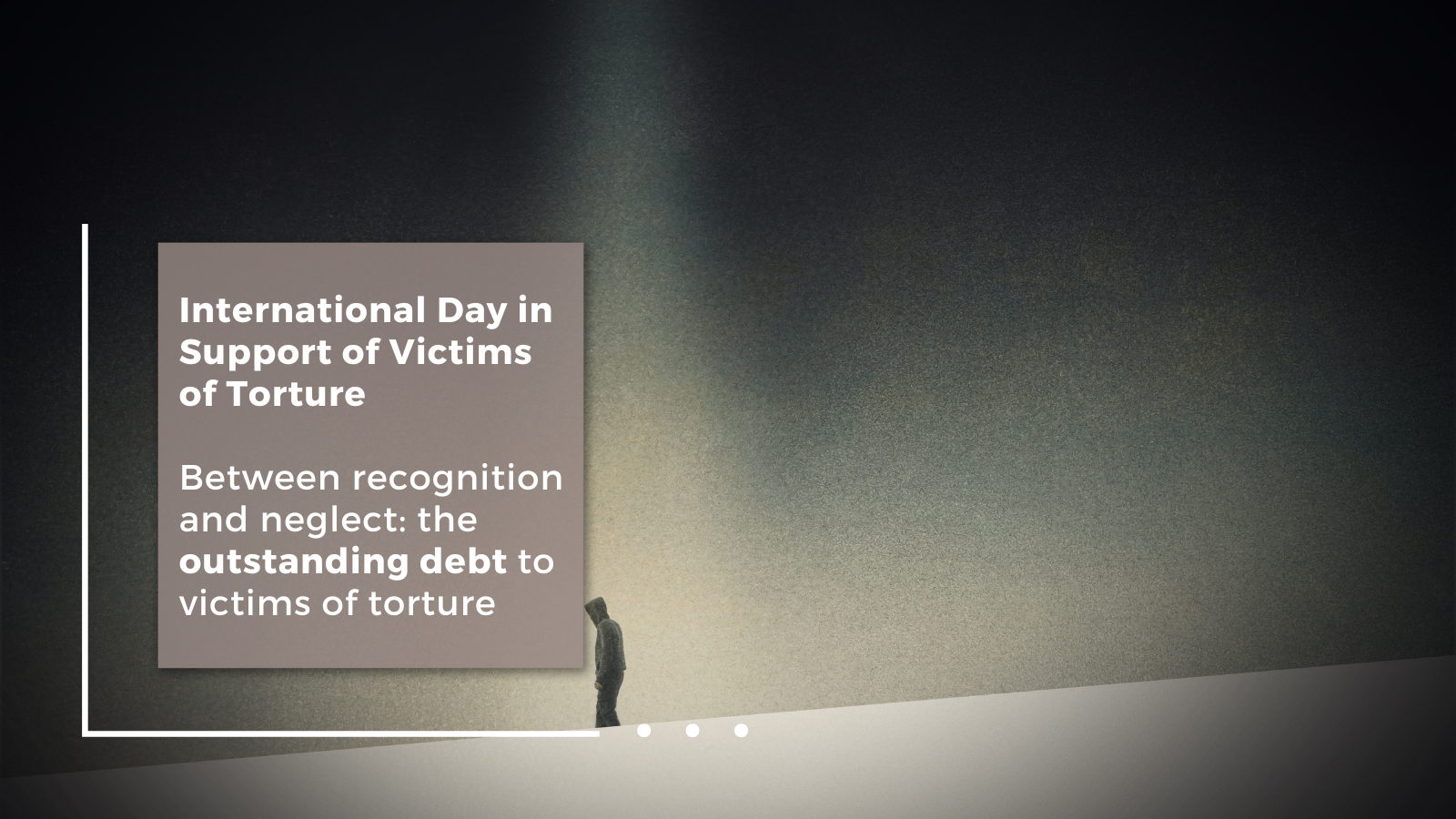
Between recognition and neglect: the outstanding debt to victims of torture
On 26 June, as has been the case every year since 1997, the International Day in Support of Victims of Torture is observed. The truth is that, when referring to this day, particular emphasis is often placed on the international legal instruments designed to eradicate torture. However, the significance of the day does not lie in the celebration of the Convention against Torture and Other Cruel, Inhuman or Degrading Treatment or Punishment (known as CAT). In reality, the purpose of the day is to ensure that we do not forget those who have been victims of torture and how they struggle day by day to recover.
In parallel with this international instrument, in June 2025 the World Organisation Against Torture published the Global Torture Index. In it, they conclude that, despite the ratification of the CAT by 175 states, no region or political system is immune to this practice. It is treated as a sort of ‘trump card’ by state security forces and takes place in police stations, prisons and in contexts of armed conflict. In Latin America, Mexico, El Salvador and Colombia are among the countries classified as ‘high risk’. The report thus exposes the gap between legal commitment and reality.
Victims of torture are legally protected under Article 14 of the CAT, which states that States are obliged not only to protect them against torture but also to ensure fair and adequate compensation for the victims. Although this article provides little detail on how to assess what constitutes ‘fair and adequate’ compensation, its intention goes beyond mere financial reparation – which is how States tend to interpret it when invoking the provision.
Rather, Article 14 ensures comprehensive redress for victims. More than money, victims and survivors need medical and psychological support. The aim is to achieve the most complete rehabilitation possible. For this very reason, an immediate financial settlement is not enough; the support process must address individuals from a humanistic perspective and not merely as a consequence to be remedied with the quickest possible solution.
In this context, on 20 January 2026, Alice Jill Edwards, the United Nations Special Rapporteur, introduced a new international instrument concerning torture and inhuman or degrading treatment. This is the Charter of the Rights of Victims and Survivors of Torture and Other Cruel, Inhuman or Degrading Treatment or Punishment, a document drawn up from the perspective of survivors.
The Charter is intended to be adopted by States as a legal framework for action, and is an invaluable tool for this purpose, as it was drawn up on the basis of the testimonies, experiences and opinions of those who have been victims of such practices. It aims to be more than just a legal resource; it is a detailed guide in which survivors address States directly to explain exactly what they need from them throughout the process.
More than 120 people contributed their experiences to the text, and it is they who set out seven articles covering four pillars of action: accountability, justice, reparation and rehabilitation. In particular, Article 6 sets out what both reparation and rehabilitation must entail and how they should be carried out: medical care, gender- and age-sensitive services, confidentiality, and support in dealing with socio-economic repercussions. It is they who, above all, emphasise that their dignity must be restored, as this is the primary target of torture.
Whilst this is the first time in the history of international law that a legal instrument has been drafted by the very people for whom the law is intended, this historic development coincides with a sharp decline in funding allocated to the United Nations Voluntary Fund for Victims of Torture (UNVFVT).
The Fund finances around 200 NGOs that provide direct assistance to survivors. With 175 dollars, a full year of comprehensive reparation can be covered: medical and psychological care, and legal advice. It is an extraordinarily efficient model whose budget has been cut by almost 85 per cent. This is because there was an almost structural dependence on contributions from the United States, which have been drastically reduced under the current administration.
Specifically, the UNVFVT’s financial situation leaves victims who depend on it financially—and who, at the same time, are seeking legal protection from the state—even more vulnerable.
This is why, in this context, the International Day in Support of Victims of Torture cannot be reduced to a symbolic commemoration of the legal commitments undertaken. The emergence of instruments such as the Charter on the Rights of Victims and Survivors has succeeded in refocusing attention on the voices of those who have suffered these practices.
However, the strain caused by the reduction in resources demonstrates that precise legal frameworks are not enough; rather, it depends on the political will of States to uphold them and ensure they are effectively implemented. Without adequate funding, the legal progress that has been made risks becoming empty promises. Ultimately, the priority must always be to guarantee the necessary resources for the comprehensive rehabilitation of victims, ensuring that their dignity is not violated once again through inaction or indifference.
Ana Nerea Saad Moisés, FIBGAR Contributor
