


FIBGAR participates in Brussels presentation of the XVI EU-LAC Policy Brief on transnational organised crime
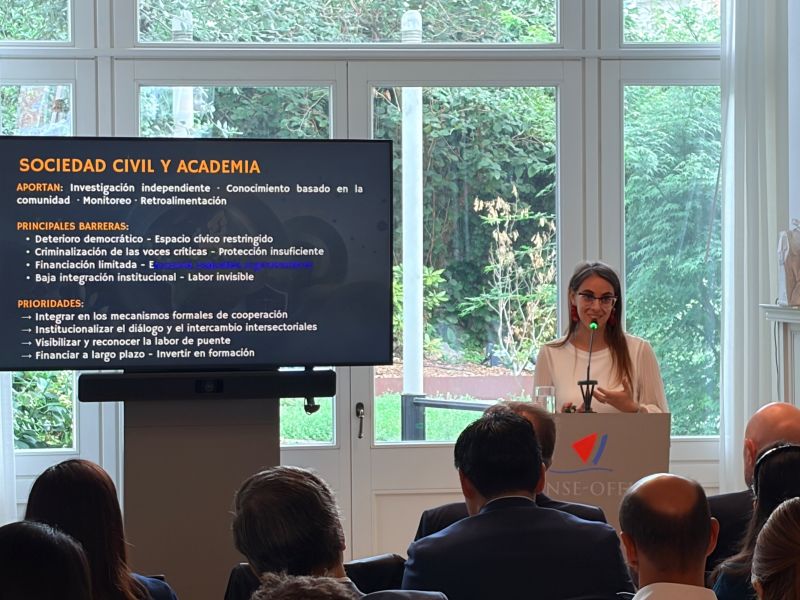
FIBGAR participated in Brussels in the presentation of the XVI EU-LAC Policy Brief, a publication developed in collaboration with the EU-LAC Foundation and focusing on how to strengthen cooperation between the European Union and Latin America and the Caribbean in addressing transnational organised crime through a whole-of-society approach.
On 8 September 2026, Brussels hosted the presentation of the XVI EU-LAC Policy Brief, “Advancing the Whole-of-Society Approach in EU-LAC Cooperation Against Transnational Organised Crime.” The event was organised by the EU-LAC Foundation and the Mission of Peru to the European Union, bringing together representatives of European and Latin American and Caribbean institutions and other stakeholders working on bi-regional cooperation and the fight against organised crime.
FIBGAR was represented by its Executive Director, Alessia Schiavon, who presented the main findings and recommendations of the Policy Brief. The publication is the result of a collaborative process involving the EU-LAC Foundation, FIBGAR and Erasmus University Rotterdam.
The September presentation marked another important step in a collaboration between FIBGAR and the EU-LAC Foundation that has developed throughout 2026.
The process began with the seminar “Advancing the Whole-of-Society Approach in EU-LAC Cooperation Against Transnational Organised Crime”, held in Brussels on 15 June 2026 and organised by the EU-LAC Foundation as part of EU Crime Fighting Week 2026.
The seminar brought together around 100 participants from more than 30 EU and Latin American and Caribbean countries, including representatives from civil society, local communities, the private sector, practitioners, researchers and academia. Discussions focused on the first year of implementation of the EU-LAC Alliance for Citizen Security, the role of civil society and academia, and the contribution of private and local actors to tackling transnational organised crime.
The conclusions and recommendations emerging from the June seminar provided the basis for the XVI EU-LAC Policy Brief. The publication seeks to translate the discussions held during the seminar into concrete recommendations for policymakers and other relevant stakeholders, building on the momentum generated by the IV CELAC-EU Summit, the EU-LAC Alliance for Citizen Security and existing bi-regional mechanisms and platforms.
A central message of the Policy Brief is that transnational organised crime operates through increasingly adaptive networks that connect illicit markets with legal economies. Addressing these dynamics therefore requires responses that are equally adaptive, coordinated and inclusive.
The Policy Brief highlights the importance of moving beyond fragmented approaches and strengthening cooperation among public institutions, civil society, academia, local communities and the private sector. It also underlines the need to create meaningful spaces for civil society and academic participation in bi-regional cooperation, including through independent knowledge, monitoring and the identification of emerging risks.
The report further stresses the importance of strengthening the participation of local communities and ensuring that different stakeholders are involved from the early stages of policy design and implementation.
For FIBGAR, this process represents an important opportunity to contribute to the bi-regional debate on justice, human rights and the fight against impunity, while bringing the perspective of civil society into discussions on how to address transnational organised crime.
Our participation in the June seminar, our contribution to the development of the Policy Brief and its presentation in Brussels in September reflect a continuous process of dialogue, research and collaboration with the EU-LAC Foundation.
Through this collaboration, FIBGAR continues to contribute to efforts to strengthen international cooperation and promote responses to transnational crime that place human rights, communities and the rule of law at the centre.
Further information: https://eulacfoundation.org/en/advancing-whole-society-approach-eu-lac-cooperation-against-transnational-organised-crime
