


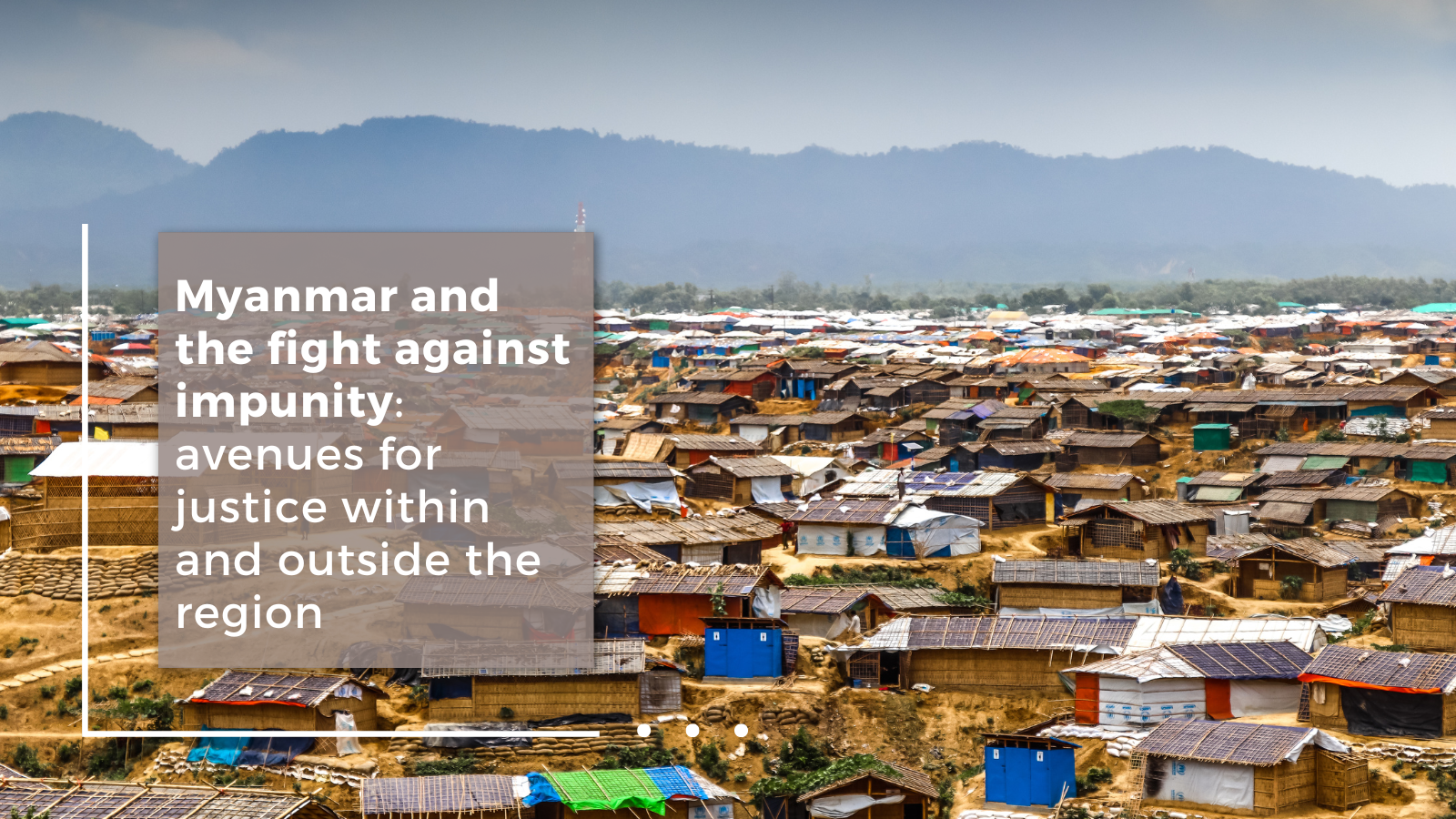
Myanmar and the fight against impunity: avenues for justice within and outside the region
For decades, Myanmar has been plagued by internal armed conflict, ethnic tensions and serious human rights violations that have affected numerous communities across different regions of the country. Persistent patterns of violence against the civilian population have been extensively documented, contrasting with the absence of effective domestic mechanisms to investigate and punish those responsible for these abuses.
Within this context, the Rohingya population has suffered systematic persecution characterised by the denial of their citizenship, restrictions on their freedom of movement, structural discrimination and recurring episodes of violence. The so-called “clearance operations” carried out in Rakhine State led to the forced displacement of hundreds of thousands of people to Bangladesh and gave rise to numerous complaints lodged with both international and national mechanisms.
Investigations carried out by international organisations and human rights mechanisms have documented widespread killings, forced displacement, the deliberate destruction of villages, arbitrary detention, torture and systematic sexual violence against the civilian population. The Independent International Fact-Finding Mission on Myanmar concluded that sexual violence was deliberately used as a tool to intimidate, terrorise and punish entire communities. Women, girls, men, boys and people of diverse gender identities were victims of rape, sexual slavery and other forms of sexual and gender-based violence committed by members of the armed forces.
Furthermore, in this case, the fact that state agents used fake Facebook accounts to systematically spread false narratives, exacerbating the persecution and displacement of the Rohingya people, has exposed a complex issue regarding the use of modern technology: how governments can use disinformation as a weapon to dominate the information space, suppress human rights and incite violence.
In this regard, although the crimes committed against the Rohingya population constitute one of the most well-documented episodes of mass violence in Myanmar, the situation worsened further following the military coup of February 2021.
The armed forces’ seizure of power triggered a new phase of internal armed conflict, characterised by an intensification of attacks against the civilian population. International organisations have documented bombings of schools, hospitals, religious buildings and other civilian infrastructure, as well as the continued use of torture, forced labour and sexual violence. The conflict has caused the displacement of millions of people, deepening a humanitarian, political and economic crisis that continues to affect the entire country. In this regard, reports following the 2021 coup d’état highlight the persistence of patterns of persecution, repression and violence against various groups within the civilian population.
In recent years, the Independent Investigative Mechanism for Myanmar (IIMM) has gathered evidence of systematic torture in military-controlled detention centres, including beatings, electric shocks, strangulation, sexual violence and summary executions.
According to its investigations, these abuses follow organised patterns involving not only the direct perpetrators but also commanders responsible for overseeing the locations where the crimes were committed.
In this context, the persistence of these violations and the absence of independent domestic mechanisms capable of investigating and prosecuting such conduct have contributed to a climate of impunity that continues to affect victims and their communities, reinforcing the need for judicial responses beyond Myanmar’s borders.
The pursuit of justice for crimes committed in Myanmar
In Myanmar, the ongoing conflict, the involvement of the armed forces in the reported abuses and the absence of independent institutions have made it extremely difficult to carry out effective domestic investigations. Consequently, this lack of effective access to justice within Myanmar has led victims, human rights organisations and civil society actors to turn to international mechanisms and foreign national jurisdictions in an attempt to secure effective accountability.
In this regard, various international bodies have made progress in documenting the facts and gathering evidence. However, despite this, there are jurisdictional restrictions that have excluded significant aspects of the violence that occurred in Myanmar, as the country is not a State Party to the Rome Statute. These limitations have reinforced the importance of universal jurisdiction as an indispensable complementary tool for prosecuting international crimes, which might otherwise remain in the shadow of impunity.
These accountability efforts span a broad timeframe, and two main strands can be identified. On the one hand, initiatives aimed at investigating crimes committed against the Rohingya population and other ethnic minorities prior to the 2021 coup, including events that occurred during the so-called ‘clearance operations’. On the other hand, investigations seeking to address human rights violations and alleged international crimes perpetrated following the military junta’s seizure of power. Although these are distinct contexts, both phenomena reveal persistent patterns of violence and impunity that have driven the search for justice mechanisms beyond Myanmar’s borders.
Civil society organisations have played a central role in this process. In addition to documenting human rights violations and supporting victims, they have spearheaded initiatives aimed at activating these jurisdictional mechanisms outside Myanmar. These efforts have sought not only to promote criminal investigations, but also to ensure that victims’ experiences are heard and recognised in judicial and public forums.
The emergence of universal jurisdiction initiatives in the Asia-Pacific region
One of the most significant developments in recent years has been the emergence of regional efforts aimed at using universal jurisdiction to investigate crimes committed following the 2021 military coup. Various civil society organisations, together with victims’ groups and human rights defenders, have initiated legal proceedings in different countries across Asia and the Pacific with the aim of broadening access to justice.
Among the most active actors in this field is the Myanmar Accountability Project (MAP), which has pursued strategic litigation in various jurisdictions across the region, identifying national legal frameworks that permit the prosecution of international crimes and collaborating with local organisations to file the relevant complaints.
One of the first breakthroughs in this regard occurred in Turkey, where an investigation was opened into allegations of torture linked to Myanmar. Although the case initially concerned Rohingya victims, complaints regarding crimes committed following the 2021 coup were subsequently included. The opening of this investigation was considered an important precedent as it was one of the first accepted proceedings relating to post-coup violence.
Initiatives have also been launched in the Philippines and Indonesia. In both countries, human rights organisations and victims have explored the possibilities offered by national legal systems to trigger investigations into international crimes committed in Myanmar. Although these efforts have faced procedural and political obstacles, they have helped to open a regional debate on the scope of universal jurisdiction and the responsibilities of states regarding particularly serious crimes.
Another of the most notable cases is the one brought in East Timor by the Chin Human Rights Organisation (CHRO), which filed a complaint regarding crimes allegedly committed against the population of Chin State following the military coup. The alleged offences include sexual violence, attacks on hospitals and religious buildings, forced displacement and other acts that could constitute war crimes and crimes against humanity. The initiative has been presented as an example of the growing prominence that regional civil society is acquiring in the pursuit of justice.
Beyond specific procedural advances, these initiatives have helped to introduce the debate on universal jurisdiction in the countries of the Asia-Pacific region, to challenge the limits of the traditional principle of non-interference that has historically characterised the Association of Southeast Asian Nations (ASEAN), and to generate greater public discussion on access to justice for victims in Myanmar.
At the same time, they have helped to bring the victims’ demands to the fore and broaden the scope for cooperation between local organisations, international mechanisms and judicial authorities, thereby helping to preserve evidence, highlight the violations committed and keep open avenues of access to justice that would otherwise remain closed.
Although they still face significant legal and political challenges, these initiatives reflect a growing willingness to explore mechanisms to combat impunity.
The Rohingya case before the Argentine courts
Among the most significant initiatives pursued under the principle of universal jurisdiction, the case brought in Argentina regarding crimes committed against the Rohingya people also stands out. The complaint was filed in 2019 by the Burmese Rohingya Organisation UK (BROUK), together with victims and human rights organisations, and focused on the persecution and “cleansing” operations carried out between 2012 and 2018 against this predominantly Muslim ethnic minority.
The case includes allegations of widespread killings, sexual violence, the destruction of villages, arbitrary detentions, forced displacement and other acts that have been characterised as genocide and crimes against humanity. Following various legal proceedings and an extensive evidence-gathering phase, the case made significant progress, leading to international arrest warrants against senior political and military officials in Myanmar, including Min Aung Hlaing.
The Argentine experience constitutes one of the most significant examples of the application of universal jurisdiction with regard to crimes committed in Myanmar and demonstrates how courts geographically and culturally distant from the events can contribute to the fight against impunity.
Conclusions
The ongoing violence, ranging from the ‘cleansing’ operations against the Rohingya population to the abuses documented following the 2021 coup, highlights the need for sustained and coordinated responses from the international community.
In this context, universal jurisdiction stands as a particularly relevant tool for addressing situations where national mechanisms are insufficient or non-existent. Initiatives launched in various countries demonstrate that the pursuit of justice can take many forms and that national courts can play an important role in the prosecution of international crimes.
Furthermore, the experience in Myanmar highlights the importance of collaboration between victims, human rights organisations, international investigative mechanisms and judicial authorities. The documentation of events, the preservation of evidence and the support provided to victims by these cooperative structures have been fundamental elements in driving forward processes that would otherwise have been unlikely to take place.
Although the challenges remain enormous, the progress made in various national and international forums shows that accountability continues to be a shared aspiration among victims, organisations and human rights defenders. It also demonstrates that the fight against impunity does not depend exclusively on international courts, and that universal jurisdiction is fundamental and decisive in the investigation of international crimes and in the protection of victims’ right to truth, justice, reparation and non-repetition.
Federica Carnevale, Project Manager at FIBGAR.
Those wishing to learn more about the procedural development of the case before the Argentine courts may consult the report Universal Jurisdiction in Argentina produced by FIBGAR, which provides a chronological analysis of the case’s progress and its main judicial milestones.
REFERENCES:
Asymmetrical Haircuts. Update on justice: universal jurisdiction in Myanmar’s neighbouring countries. Available at: https://www.asymmetricalhaircuts.com/episodes/justice-update-universal-jurisdiction-in-the-neighbourhood-for-myanmar/#transcript
Bradshaw, S. (November 2024). Disinformation and identity-based violence. Stanley Center for Peace and Security. https://stanleycenter.org/publications/disinformation-and-identity/ ; in FIBGAR, Contributions on the Impact of Disinformation on the Enjoyment and Realisation of Human Rights, 28 February 2025. Available at: https://fibgar.es/wp-content/uploads/2025/03/Aportaciones-sobre-el-impacto-de-la-desinformacion-en-el-disfrute-y-la-realizacion-de-los-derechos-humanos.pdf
FIBGAR. Universal Jurisdiction in Argentina. Madrid, 2026. Available at: https://fibgar.es/wp-content/uploads/2026/03/Informe-Jurisdiccion-Universal-Argentina-Espanol.pdf
Justice Info. Will ASEAN take a step forward on universal jurisdiction? Available at: https://www.justiceinfo.net/en/159252-will-asean-step-up-on-universal-jurisdiction.html
United Nations Regional Information Centre for Western Europe (UNRIC). Myanmar military committed systematic sexual violence against ethnic minorities. Available at: https://unric.org/es/los-militares-de-myanmar-cometieron-violencia-sexual-sistematica-contra-las-minorias-etnicas/
UN News. Myanmar: UN investigators denounce systematic torture and new atrocities following the military coup. Available at: https://news.un.org/es/story/2025/08/1540320
