

Two Days to Rethink Universal Jurisdiction and the Challenges of International Justice
On 17 and 18 September, FIBGAR, together with the European Center for Constitutional and Human Rights (ECCHR), brought together legal professionals, academics, institutional representatives and civil society organisations in Rome to reflect on the current challenges facing universal jurisdiction and international justice.
Supported by the Global Initiative Against Impunity, the Fondazione Basso and the European Union, the two-day event provided an opportunity to address these issues from complementary perspectives.
From Principles to Practice: The Challenges of Universal Jurisdiction in Europe
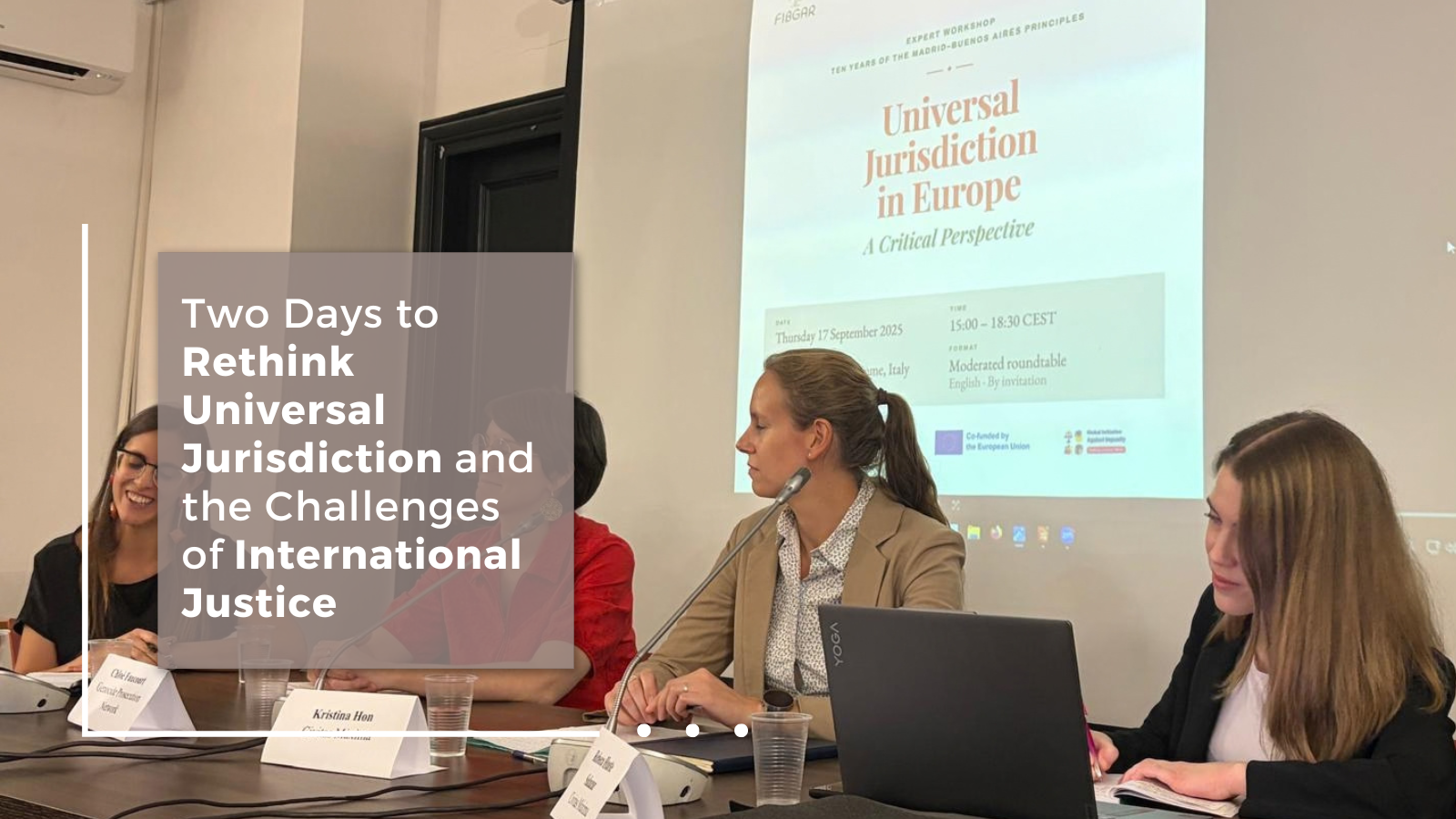
The first day, organised by FIBGAR under the title “Universal Jurisdiction in Europe – A Critical Perspective”, centred on a key question: ten years after the Madrid–Buenos Aires Principles, to what extent has universal jurisdiction translated into effective accountability mechanisms, and what challenges does it currently face?
During the opening session, participants recalled the process that led to the development of the Principles. In 2014, FIBGAR organised the First International Congress on Universal Jurisdiction, followed by the Second International Congress, held in Buenos Aires in 2015. This process resulted in the Madrid–Buenos Aires Principles, conceived as a reference framework for strengthening the effective, coherent and coordinated application of universal jurisdiction.
Ten years later, the meeting provided an opportunity to revisit these issues in light of the experience accumulated over the past decade and, in particular, the obstacles that continue to condition the practical application of the principle.
The first panel, “The Gap Between Principle and Practice”, brought together Chloé Faucourt, Judicial Cooperation Officer at the Genocide Prosecution Network; Rebeca Huete Salazar, Legal Counsel at Civitas Maxima; and Kristina Hon, Senior Legal Counsel at Civitas Maxima.
The discussion highlighted that the existence of a legal framework allowing for the exercise of universal jurisdiction does not automatically translate into investigations and proceedings. As Chloé Faucourt explained, most European Union Member States have some form of universal jurisdiction, although this is frequently subject to conditions such as the presence or residence of the alleged perpetrator in the territory, prior authorisation requirements or other limitations.
Against this backdrop, cooperation between national authorities emerged as one of the central themes of the day. The Genocide Prosecution Network was presented precisely as a space designed to promote cooperation and the exchange of knowledge among authorities involved in the investigation and prosecution of genocide, crimes against humanity and war crimes.
The experience of proceedings conducted in Germany concerning crimes committed in Syria was cited as an example of some of the factors that can make an investigation of this kind possible. The Koblenz case demonstrated the importance of having an appropriate legal framework, specialised units with sufficient resources and expertise, access to evidence and testimony, support for victims and witnesses, and international cooperation mechanisms, including cooperation between French and German authorities. The contribution of civil society organisations, including Syrian organisations, to the documentation and development of these cases was also highlighted.
At the same time, the discussion focused on the difficulties that arise once proceedings reach the courts. From Civitas Maxima, Rebeca Huete Salazar and Kristina Hon addressed issues relating to reparations for victims, witness protection, the length of investigations and the effects that prolonged periods of uncertainty can have both on confidence in justice mechanisms and on the availability of evidence and the safety of those involved in proceedings.
In this regard, the need to manage victims’ expectations appropriately and to pay attention to the consequences that judicial decisions may have beyond the judgment itself was emphasised. The importance of ensuring that protection mechanisms remain operational after proceedings have concluded, when convicted individuals may be released or deported, was also raised.
Another point highlighted was the need to strengthen the specialised capacities of prosecutors, investigators and judges. The discussion on the Madrid–Buenos Aires Principles placed particular emphasis on the relevance of specialised structures and on the need to develop practical tools that can translate these recommendations into national systems.
The second panel, “Building Accountability: Cooperation, Civil Society & the Road Ahead”, featured Chantal Meloni, Senior Legal Advisor at the European Center for Constitutional and Human Rights (ECCHR); John Stauffer, Legal Director / Deputy Executive Director at Civil Rights Defenders; and Hope Rikkelman, Executive Director of the Nuhanovic Foundation.
The discussion explored in greater depth the role of civil society in universal jurisdiction proceedings and the need to build cooperative relationships that allow its expertise to be harnessed without compromising its independence.
The experience of cases relating to Syria once again served as an important point of reference. Chantal Meloni highlighted the role played by civil society organisations in documenting crimes, supporting victims and survivors, and building cases before national courts. At the same time, questions were raised regarding the uneven application of these mechanisms in different contexts and the need to examine which situations are investigated and which remain outside the scope of national proceedings.
The relationship between migration policies and investigations into international crimes was also addressed, as was the risk that certain structural forms of responsibility may remain outside the scope of proceedings when investigations focus exclusively on particular perpetrators or offences.
Drawing on the experience of the Nuhanovic Foundation, Hope Rikkelman emphasised the need to place victims at the centre of proceedings. The organisation has been involved in supporting victims and survivors and in developing support mechanisms within universal jurisdiction proceedings in the Netherlands. This experience provided an opportunity to reflect on the importance of psychosocial support, communication with affected communities, and appropriate referral and support pathways throughout the different stages of proceedings.
The Dutch experience also showed that civil society can help identify gaps in justice systems and promote changes to institutional mechanisms for supporting victims. At the same time, it was stressed that organisations must retain their independence and their ability to scrutinise the actions of the authorities themselves.
John Stauffer brought the experience of Civil Rights Defenders in the areas of documentation, support for human rights defenders, evidence collection, advocacy and monitoring of judicial proceedings. The discussion once again highlighted some of the obstacles to accessing the testimony of victims and witnesses, particularly where there are concerns about trust in the authorities, uncertainty regarding migration status or risks to their safety.
A cross-cutting idea emerged from this exchange: cooperation cannot be limited to relations between prosecutors’ offices and courts. International justice proceedings also require the participation of civil society organisations, affected communities, specialised professionals and international mechanisms capable of sharing information and expertise.
Italy and the Challenge of International Justice
The discussion continued on Friday 18 September with a second day focused on Italy’s role in international justice and the specific challenges posed by its legal and institutional framework.
Under the title “Rafforzare il contributo dell’Italia alla giustizia internazionale”, the event organised by ECCHR addressed the different ways in which Italian authorities can contribute more effectively to the investigation and prosecution of international crimes.
Italy has significant experience in the field of international justice and judicial cooperation. However, important challenges remain within its domestic legal framework and in its capacity to investigate and prosecute international crimes. The event therefore sought to open a space for discussion on these issues and on the measures needed to strengthen Italy’s cooperation with the International Criminal Court (ICC).
The meeting brought together different perspectives from the legal, academic, institutional and civil society spheres, with contributions from Chantal Meloni, Professor at the University of Milan; Antonio Vallini, from the University of Pisa; Federica Genovesi, Legal Officer at the Nuhanov Foundation; Chloé Faucourt, Judicial Cooperation Officer at the Genocide Prosecution Network; and Raffaele Piccirillo, representing the Public Prosecutor’s Office. The closing remarks were delivered by Niccolò Figá-Talamanca, from Non c’è pace senza giustizia.
One of the main focuses of the discussion was the state of the Italian legal framework. Drawing on the experience of other European countries, participants discussed the need to move towards more specific regulation of international crimes and to clarify the tools available to Italian authorities so that they can exercise their jurisdiction effectively.
In this context, the historical evolution of the Italian model and some of the issues that remain unresolved were addressed, including the need for appropriate legal instruments and for the conditions necessary to enable existing powers to be activated in practice.
The discussion also highlighted that the existence of legal powers is not sufficient in itself. Investigating international crimes requires specialised expertise, appropriate structures, resources and mechanisms for cooperation with other national and international authorities.
From an institutional perspective, the importance of continuing to develop the Italian model and addressing existing gaps through reforms that allow for a more systematic approach to the investigation and prosecution of international crimes was also discussed. In this regard, the need to move towards specialised structures and strengthen cooperation between authorities, victims and civil society organisations was emphasised.
Cooperation once again emerged as a central element. The transnational nature of many crimes investigated through universal jurisdiction makes it necessary to share information, evidence and expertise between different countries and institutions. The experience of other European States, including that of the Netherlands, was used as a reference point to examine how cooperation with civil society can be integrated into institutional processes without compromising the independence of organisations.
The role of digital evidence and open-source information was also discussed, as these are becoming increasingly relevant in the documentation of international crimes. Civil society organisations often have the capacity to collect and preserve information that may subsequently prove relevant to investigations. Alongside this, the need to strengthen security and protection measures for witnesses and for those involved in these proceedings was highlighted.
The event also provided an opportunity to reflect on a dimension that extends beyond legal reforms: the need to foster greater public understanding of international justice.
Awareness-raising and civil society literacy were presented as long-term processes, but also as elements that can help place these issues on the public agenda and contribute to legislative and institutional change.
The discussion concluded with a shared reflection on the need to connect the different levels of action: legal, institutional, academic and civil society. Only through such coordination is it possible to build national capacities capable of responding effectively to international crimes.
Two Days, One Common Goal: Addressing Impunity
The consecutive organisation of these two events provided an opportunity to approach international justice from two complementary perspectives: on the one hand, the role of universal jurisdiction as a tool to ensure that international crimes do not go unpunished; and, on the other, the need to strengthen national systems and international cooperation in order to enable the effective investigation and prosecution of these crimes.
Throughout the two days, the experiences shared demonstrated that universal jurisdiction cannot be understood solely as a normative issue. Its effective application depends on the existence of appropriate legal frameworks, specialised structures, resources, cooperation between authorities, access to evidence, protection and support for victims and witnesses, and a civil society capable of participating actively and independently.
For FIBGAR, these spaces for exchange are essential to connect legal reflection with the challenges arising in practice and to strengthen networks of cooperation among civil society organisations, legal professionals, institutions and other actors committed to the fight against impunity.
We would like to express our particular thanks to the European Center for Constitutional and Human Rights (ECCHR), the Fondazione Lelio Basso, the European Union and the Global Initiative Against Impunity for their collaboration and support in organising these events, as well as for their commitment to creating spaces for dialogue, the exchange of experiences and joint work in response to the current challenges facing international justice.
For these two days, Rome became a space for reflection and exchange on the progress made over the past decade and the challenges that remain in making international justice effective. The events provided an opportunity to bring together experiences, lessons learned and tools from different fields and contexts, reaffirming the importance of strengthening national capacities, international cooperation and the role of civil society in the fight against impunity.
