


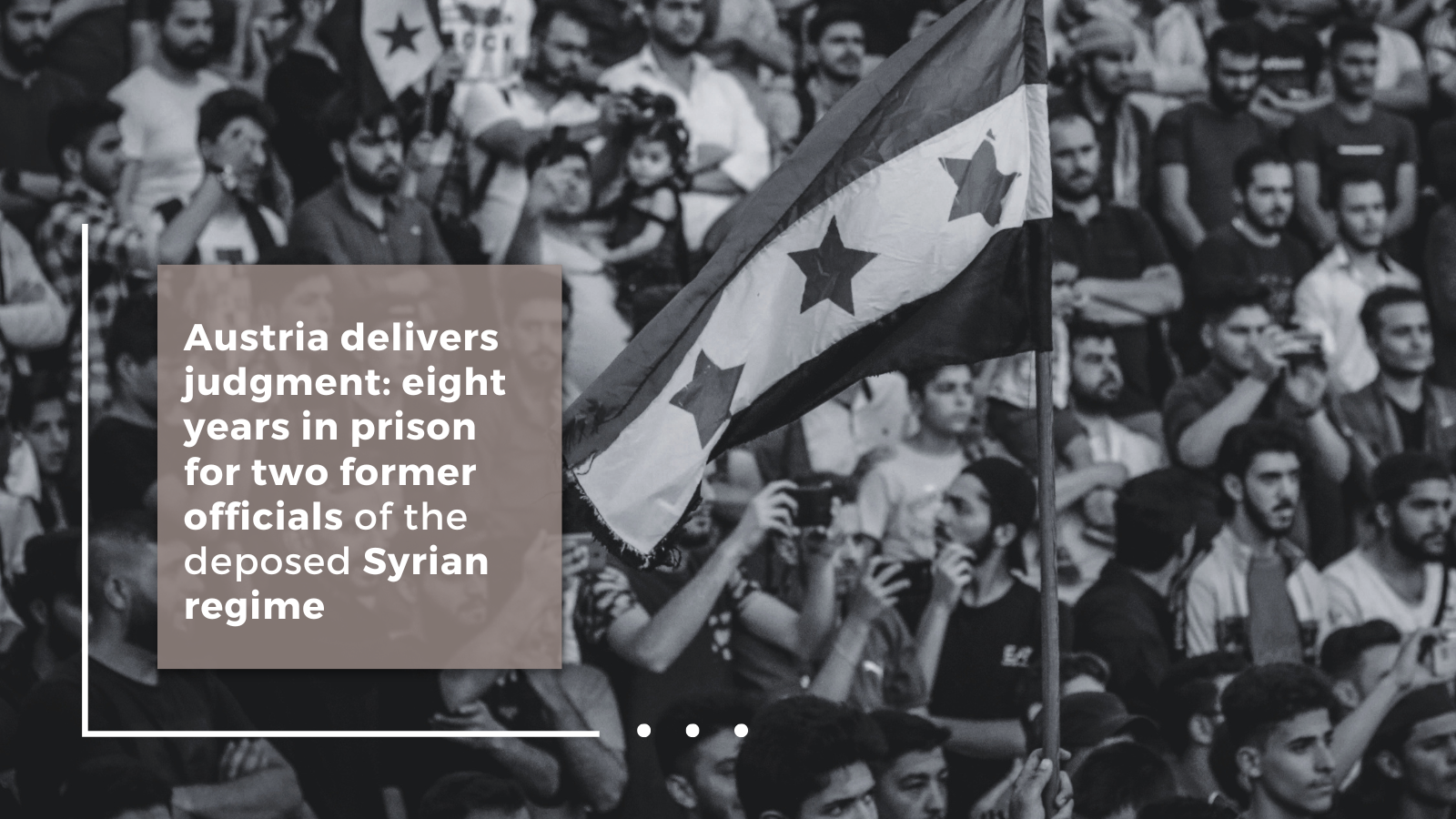
Austria delivers judgment: eight years in prison for two former officials of the deposed Syrian regime
On 6 July 2026, the Vienna Regional Court sentenced Khaled Al-Halabi, a former brigadier general in the Syrian intelligence services, and Musab Abu Rukbah, a former lieutenant colonel and former head of investigations at the Raqqa criminal police, to eight years in prison for acts of torture, sexual coercion and grievous bodily harm committed against a total of 21 civilians during the early years of the Syrian revolution. The judgment came just one month after the trial began, on 1 June 2026, in one of the most significant universal jurisdiction proceedings opened in Austria to date.
The case: systematic repression in detention centres in Raqqa
As we explained in previous articles, the events under consideration date back to the period between 2011 and 2013, during the repression of protests against the government of Bashar al-Assad. Al-Halabi and Abu Rukbah, who applied for asylum in Austria in 2015 and have resided in the country ever since, were accused of ordering, facilitating or failing to prevent acts of physical and psychological violence against detainees in centres under their authority in Raqqa Governorate.artículos anteriores
During the thirteen days of hearings, numerous former detainees travelled from different European countries and from Syria itself to give evidence. They described being brutally beaten by guards while in the custody of both defendants, as well as being subjected to electric shocks, confinement in small and overcrowded cells, and prolonged nudity accompanied by repeated baths in cold water. One witness told the court that Al-Halabi personally interrogated him and administered electric shocks to the soles of his feet using cables, and stated that, years later, he “is still afraid”. According to the Austrian prosecution, both defendants acted on the direct orders of the deposed regime, using violence in a systematic and standardised manner, with the stated aim of deterring the population from continuing to participate in the protest movement. Al-Halabi has remained in pre-trial detention since December 2024, while Abu Rukbah was released under less restrictive measures after appealing his detention before the Vienna Higher Regional Court.
The judgment: command responsibility and reparations for victims
The lay judges’ panel concluded that both defendants had committed “State-organised systematic torture” and stressed that Austria has jurisdiction over these crimes and that the limitation period had not expired. The presiding judge highlighted that the first defendant had personally resorted to violence on one occasion, while the second had done so on multiple occasions, and emphasised that the aim of both was to deter the population from taking part in future demonstrations.
A particularly relevant aspect of the judgment is the reasoning concerning command responsibility. The court described the two convicted men as “guarantors of the custody” of their prisoners, responsible both for protecting their integrity and for preventing their subordinates from using violence against them: the defendants not only failed to prohibit the use of violence by their subordinates, but also actively used violence themselves. With regard to Al-Halabi in particular, the court noted that, as head of the intelligence service, he was responsible for what occurred within his area of responsibility and could have taken concrete measures to improve the detainees’ situation, such as removing the instruments of torture from the centre.
Among the aggravating circumstances, the court took into account the particularly reprehensible motive of the defendants — suppressing a movement for freedom —, the victims’ helplessness, as they were bound and blindfolded, the repeated use of weapons to inflict suffering — electric guns, batons and Kalashnikov rifles — and the fact that minors were also tortured. The prolonged period over which the offences were committed was also considered an aggravating factor. As mitigating circumstances, the court took into account the time elapsed since the offences were committed and the lengthy duration of the judicial proceedings, which led it to reduce the sentences from the near-maximum terms sought by the prosecution — nine years and six months and nine years and three months, respectively, close to the ten-year limit provided for under Austrian law. The court therefore set the final sentence at eight years in prison for both, one year and six months below the nine years and six months that Al-Halabi would otherwise have received, and one year and three months below the nine years and three months that Abu Rukbah would otherwise have received, in the absence of those mitigating circumstances.
The court awarded victims compensation of €5,000 in cases of minor assault, €10,000 in cases of serious assault and, in one case, €15,000 for sexual assault, referring the victims to the civil courts to claim the remaining amounts. In total, the two convicted men will have to pay €130,000 in compensation for damages.
It is important to note that both convicted men requested time to assess their options, while the prosecution filed appeals and motions for annulment in both cases; the verdicts are therefore not yet legally final.
A trial that does not take place in isolation
The Vienna judgment joins other proceedings opened in parallel in Europe against former officials of the deposed Syrian regime. In March 2026, the Westminster Magistrates’ Court in London began the trial of former Syrian Air Force Intelligence colonel Salem al-Salem, accused of murder, crimes against humanity and torture — a case regarded as a legal precedent in the United Kingdom — while, that same month, a Berlin court began the trial of the leader of a militia loyal to the deposed regime, accused of crimes against humanity, the killing of protesters and the transfer of detainees to the regime’s security forces, where they were subjected to torture and ill-treatment. As we noted at the beginning of this process, the Al-Halabi and Abu Rukbah case thus joins those already underway in Germany, France, Sweden, the Netherlands and the United Kingdom, consolidating Europe as the main judicial arena for accountability for crimes committed during the repression in Syria.
Conclusions
The judgment handed down by the Vienna Regional Court confirms the increasingly established role of universal jurisdiction as an accountability tool for crimes committed during the repression of the Syrian revolution. The judicial reasoning on command responsibility — in describing the convicted men as “guarantors of the custody” of their prisoners — is particularly valuable as a precedent, insofar as it holds accountable not only those who directly perpetrate violence, but also those who, from a position of authority, fail to prevent it.
At the same time, the case highlights the limitations and tensions inherent in these proceedings: the verdicts are not yet final, as both the defence and the prosecution have lodged appeals, and the sentences were reduced due to the considerable time elapsed since the events and the lengthy duration of the judicial proceedings. Nevertheless, the fact that this trial has reached a judgment in parallel with other proceedings underway in London and Berlin confirms that universal jurisdiction, even under a model such as Austria’s that requires a link to the country, continues to offer Syrian victims a concrete avenue to access justice, truth and reparation, years after the events.
Federica Carnevale, Project Manager at FIBGAR.
For a comprehensive review of the origins of the case, the Austrian legal framework on universal jurisdiction — which requires a link to the country, satisfied in this case by both defendants’ residence in Austria — and the involvement of European and Israeli intelligence services in the transfer of Al-Halabi to Austrian territory, please refer to our previous publication: FIBGAR – Austria begins historic trial under the principle of universal jurisdiction against two former Syrian officials accused of torture.FIBGAR – Austria inicia un histórico juicio bajo el principio de jurisdicción universal contra dos exfuncionarios sirios acusados de tortura.
REFERENCES:
SANA News Agency (6 July 2026). Vienna court sentences two former Syrian regime officials to prison for torture. Available at: https://sana.sy/es/local/2320123/https://sana.sy/es/local/2320123/
SANA News Agency (6 July 2026). Austria tries two former officials of the deposed regime for torture in Syria. Available at: https://sana.sy/es/breaking-news/2320056/https://sana.sy/es/breaking-news/2320056/
TRIAL International, Center for Justice and Accountability, Civitas Maxima, European Center for Constitutional and Human Rights (ECCHR), International Federation for Human Rights and REDRESS (2026). Universal Jurisdiction Annual Review 2026 (UJAR 2026), Austria section, pp. 22-23. Available at: https://www.ecchr.eu/fileadmin/Publikationen/UJAR_2026_digital.pdfhttps://www.ecchr.eu/fileadmin/Publikationen/UJAR_2026_digital.pdf
