


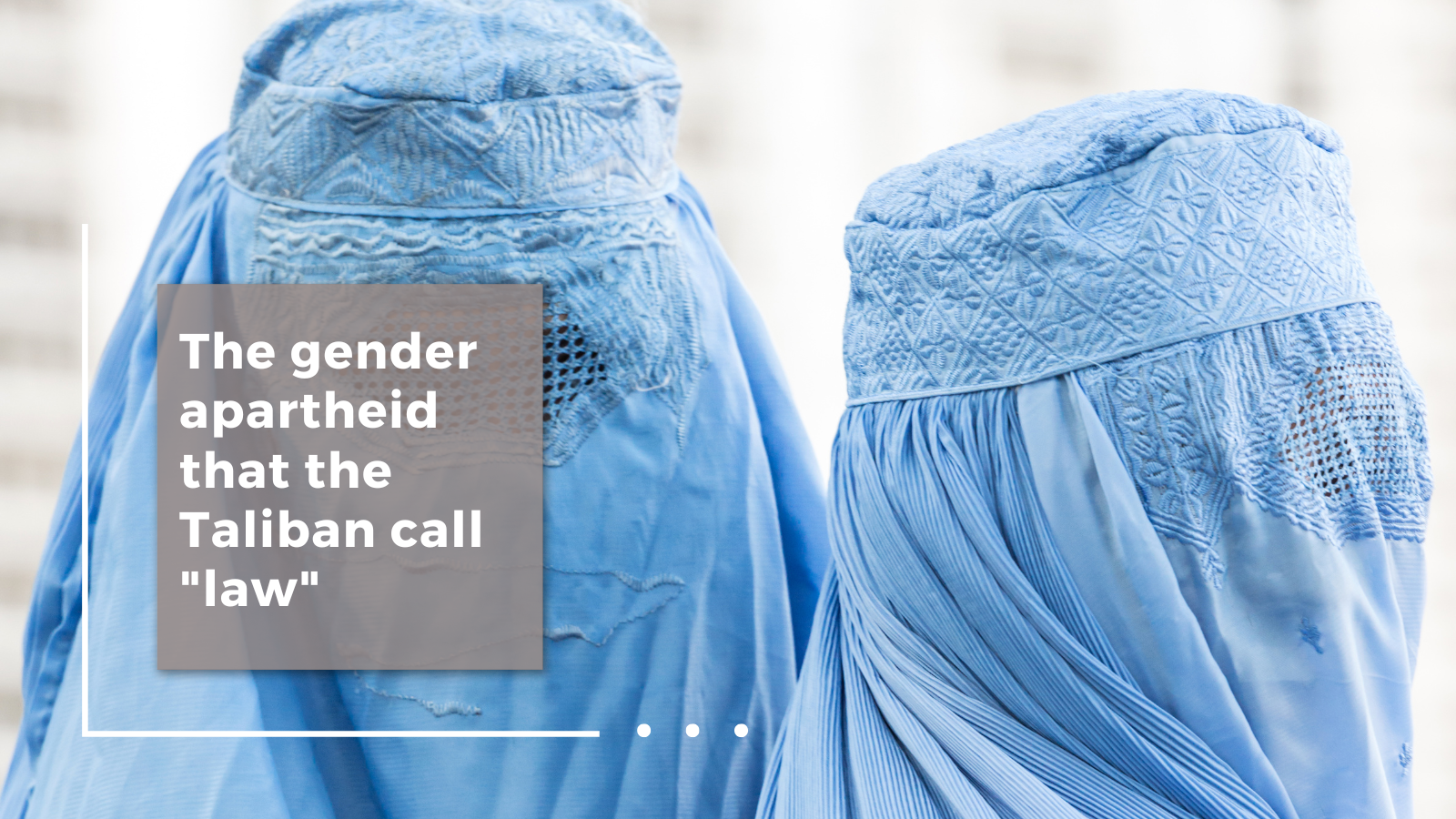
The gender apartheid that the Taliban call “law”
In August 2021 , following the collapse of the government of the Islamic Republic of Afghanistan, the Taliban seized control of the country by force and violence. Since then, this armed group, which lacks any legitimacy and any authority to make laws , has systematically persecuted women and girls in Afghanistan. In March 2022, the Taliban banned girls from secondary education, and in December of that year, they banned women from attending university.
The offensive by this radical Islamist group against the female population began with orders regarding specific cases. Among these, the Hijab Decree of May 2022 stands out. The law stipulated that if a woman did not comply with the mandatory dress code outside the home, both she and her family would be punished . With this measure, the Taliban intensified repression by shifting control into the private sphere . In other words, family members themselves began monitoring women’s clothing and movements to prevent punishment.
Over time, the Taliban moved from scattered orders to total control through the self-styled “Law on the Promotion of Virtue and the Prevention of Vice” (PVPV) , which their leader, Haibatullah Akhundzada, signed in July 2024. This text, composed of four chapters and 35 articles, gathered, expanded, and codified all previous orders to systematically control the public, professional, social, and private lives of the civilian population in Afghanistan.
Furthermore, the PVPV code institutionalizes the segregation, discrimination, and subjugation of women in Afghanistan, imposing totalitarian control over them and erasing them from public life. This extremist text thus attempts to give a veneer of legality to what is nothing more than systematic violence and oppression imposed by force.
Article 13 of the code mandates the complete erasure of women by requiring them to cover their entire bodies and faces with loose-fitting garments to prevent any “ fitna ,” or “corruption and vice.” The same article goes so far as to outlaw the female voice in public : “Women’s voices (whether in song, hymn, or loud recitation during a meeting) are also something that should be hidden.” For the Taliban, a woman’s voice is another element that generates “vice.”
The code also imposes spatial segregation , reinforcing previous bans that exclude women from parks, gyms, and other public spaces. Furthermore, it imposes total control over their mobility, prohibiting drivers from transporting women unless accompanied by a male relative ( mahram ), thus depriving them of their most fundamental freedoms.
To enforce these prohibitions, the Taliban have deployed some 3,300 members of their so-called morality police ( muhtasibin ) in the provinces. The muhtasibin monitor, among dozens of other restrictions, women’s clothing, men’s physical appearance, women’s movement, their access to public spaces and healthcare, and compliance with the ban on girls’ education beyond the sixth grade.
The United Nations Assistance Mission in Afghanistan (UNAMA) report of April 2025 documents this deployment and warns of the destructive consequences of these prohibitions. Beyond the irreparable damage to human rights and social development, this forced confinement of women has a significant economic impact. Studies published by the World Bank estimate that their exclusion from education and employment costs the country more than $1.4 billion annually.
The PVPV code comprehensively violates the Convention on the Elimination of All Forms of Discrimination against Women (CEDAW) , which Afghanistan ratified without reservations in 2003 and which remains binding on the Afghan state regardless of who controls the country. It violates the principle of equality (Articles 2 and 3), the elimination of discriminatory prejudices and customs (Article 5), access to public life (Article 7), education (Article 10), employment (Article 11), health (Article 12), and freedom of movement (Article 15.4).
According to Article 7(1)(h) of the Rome Statute of the International Criminal Court , to which Afghanistan has been a State Party since 2003, gender-based persecution committed in the context of a widespread or systematic attack against the civilian population constitutes a crime against humanity . The intentional and serious deprivation of fundamental rights imposed by the PVPV code fully fits this criminal classification.
Given the lack of internal justice mechanisms in a country controlled by the perpetrators themselves, the gravity of these systematic violations justifies recourse to international courts and universal jurisdiction to investigate and prosecute those responsible for this repressive structure. The International Criminal Court has already taken a decisive step: on July 8, 2025, it issued arrest warrants for Akhundzada and Hakim Haqqani, head of the Taliban judicial apparatus, for their alleged responsibility in the crime against humanity of gender-based persecution.
The repressive PVPV code is not a law : it codifies in writing a system of gender apartheid designed to completely erase women from public life in Afghanistan. In response, some states and organizations like RAGAA are promoting a process at the United Nations to have gender apartheid recognized as an autonomous crime in the future International Convention on the Prevention and Punishment of Crimes Against Humanity.
Given the gravity of these events, the international community, the United Nations, and the States Parties to CEDAW and the Rome Statute have a responsibility to go beyond diplomatic condemnation: to cooperate in the execution of arrest warrants and not to grant the Taliban a legitimacy they do not possess. It is imperative to activate the instruments of universal jurisdiction to end the impunity of the perpetrators of these crimes and ensure the unconditional restoration of the fundamental rights and freedoms of women in Afghanistan.
By Rahila Raya , translator, writer and human rights defender, graduate in Persian Philology from the University of Herat (Afghanistan), trained in Early Childhood Education in Spain and collaborator of RAGAA.
